Wednesday, June 1, 2016

Supercharge Your Online Marketing Skills: New Training and Workshops from Moz Academy!

Posted by rachelgooodmanmoore

[Estimated read time: 8 minutes]

Do you suffer from average ROI and low-to-moderate page optimization scores? Do you feel like your SEO has lost its spark? Have you sensed there’s something “missing” from your digital marketing strategy? If this sounds like you or someone you know, then have I got some good news for you:

Announcing Moz’s new and improved workshops and training!

Whoa! Let's check it out!

If you’ve been looking for a way to improve your marketing strategy and get better results for you or your clients, then Moz’s new training and workshops could be the solution for you.

Great! Wait... what?

giphy.gif

Chris Pratt

Great question, reader and Chris. Training and workshop sessions are comprehensive, in-depth, interactive classes designed to help you unleash your inner marketing super power. Every class comes coupled with activities like conducting a full website audit, competitive research exercises, keyword brainstorms, and more. Sound like fun? You bet it does. Almost as much fun as these guys are having:

giphy.gif

Training AND workshops? What’s the difference?

Glad you asked. Here’s the run-down on what workshops and training are all about:

Workshops are small group classes lead by a member of the Moz Academy team. They’re open to both Moz subscribers and non-subscribers alike (though it helps to have a Moz subscription or trial), and cover best practices and real-world applications for topics like website audits, keyword research, content marketing, and more.

Not just a one-sided webinar, these sessions are meant to be interactive and participants have numerous opportunities to ask questions and dig deeper. What’s more: every student who attends a workshop will leave with a custom worksheet, audit, or other interactive tool.

Access to worksheets and other in-class activities are included in the price of each workshop.

Custom training is just that: fully customized one-on-one or small group training sessions for organizations who want specialized, focused attention from Moz trainers. Custom training curricula can be designed around whatever SEO and traffic generation topics YOU want to learn about, and individual training sessions are customized to your unique business and industry. Prefer to learn in person, in a real classroom setting? Ask if we can come to you!

The best part of both training AND workshops? You’ll leave each session with not only more know-how, but also an actionable plan for how you can improve your strategy moving forward.

Paid training?! From Moz?!

One of the other things that separates these workshops and trainings from other web-based content Moz has provided in the past: they’re paid. We feel these trainings offer a unique experience for attendees that’s worth the investment, but this is, admittedly, a different route for us. To that end, I wanted to provide some transparency as to why we’ve chosen to offer paid training.

The first (and biggest) reason why we decided to go the paid training route? Customers asked for it. Here are a few examples:

“Does Moz offer Professional Services?”

“We are seeking your support and consultancy on what needs to be done on our website in order to rank higher. If that will cost extra, we will pay. Please advise.”

“How much [would it cost] for me to ask you a lot of questions for an hour? I know you guys are the best...would like to do it on the phone...a conference call would be best.”

Despite requests like these, we’d always shied away from offering paid education because of the vast number of free resources we already offer. With educational materials like the Moz Blog, Whiteboard Fridays, our Beginner's Guides, and beyond, we weren’t sure a paid option would be valuable or useful for users like you.

But as comprehensive as Moz’s free resources may be, they all share two things in common: 1.) They’re self-guided learning tools and 2.) many are one-size-fits-all. Let’s dive into each one of those a bit deeper:

An alternative to self-guided learning

While self-guided learning is great for some, it’s not a one-size-fits-all solution for all learning styles. Depending on how you learn best, self-serve resources to organize, peruse, and internalize at your own pace can either be the greatest thing since sliced bread or the greatest hurdle to actually learning something new.

To ensure we have a great option for everyone who wants to learn how to get more traffic, we created comprehensive paid trainings that combine an engaging experience with a hands-on activity to help attendees apply the topic at hand to solve a real life pain-point for their organizations.

From a learning modality perspective, this means we’re able to provide resources for all types of learners — even those who learn best from actually doing an activity at hand.

When one-size-fits-all education isn’t enough

Best practices are just that — the best practice to employ for most organizations in most scenarios. But many organizations have their own nuances and specific business cases — and for those folks, one-size-fits-all education and strategy shop talk isn’t always going to address the underlying issue or provide the best solution.

And sometimes, you may feel like this user:

...I know I have, more times than I can count.

To provide a solution for those who feel like one-size-fits-all education isn’t enough for their organization, our custom training option allows us to tailor a unique education program to your specific needs, use cases, and business.

At the end of the day, we believe the live interaction with our trainers and hands-on activities in each session make workshops a whole new ballgame when it comes to education from Moz. We also believe that the depth of instruction and take-home collateral they provide is more than worth the investment — training packages are custom-priced, and workshops are $79-per-seat early-bird pricing and $99-per-seat regular pricing.

Who are Moz training and workshops for?giphy.gif

Come one, come all! Anyone looking to refine their marketing strategy — specifically as it relates to SEO and getting found online — will find a session with their name on it. While most of our current workshop content is focused towards users with advanced beginner-to-intermediate skill levels, we’ll soon be diving deep and creating content for all levels of expertise. Since our training sessions are fully custom, they can be tailored to match you and your team’s skill level.

Some other folks who might get the most bang for their buck from Moz Academy:

  • Marketers looking to refine their skills and dive deeper
  • Agencies interested in providing more in-depth audits and insight to clients
  • Organizations looking to expand their capabilities
  • Companies who’ve brought on new employees who need training
  • Intern-training program creators
  • Marketers who have seen stagnant or lackluster results and want to supercharge their strategies

This isn’t an exhaustive list by any means — and it isn’t meant to be. Why? Because these classes weren’t designed to fill a specific use case: rather, we created them with a specific persona in mind. That persona is someone who wants to constantly push themselves to dive deeper, learn more, and do better marketing.

Why Moz Academy?

All GIFs aside, we’re incredibly excited to share these courses with you because we think they’re going to help marketers from all walks of life supercharge their skills and take their strategies to the next level. Instead of only skimming the surface about big-picture best practices and theoretic applications, group workshop and custom training attendees have a chance to dig deep into the details of SEO and inbound marketing strategy and really get their hands dirty.

Here’s what a couple recent workshop attendees have had to say:

“...the Keyword Planning Worksheet — holy moly that thing is awesome. I'll definitely be using that over and over again.”

“Presenter was very knowledgable and this could easily have filled many more hours. Great overview to get started with audits using Moz but also third party tools.”

“The technical insights into robots.txt were super helpful — really, the entire workshop was really well done!”

“The presenter did a phenomenal job — everything was super clear, engaging, and easy to apply.”

Learn more about what we cover in each of these sessions or see what’s coming up over at the Moz workshops and training home.

Current topics offered

We currently offer workshops covering four topics:

  • Performing website audits
  • Keyword research strategy
  • Content marketing
  • Gaining the competitive edge

Looking for something a little more tailored to your organization’s specific needs and interests? Our custom training curricula have covered topics like:

  • Link building
  • Video marketing
  • Identifying your target audience
  • Growing your keyword footprint
  • Local search optimization

“That’s great, but what about a class on _____?”

A class on what, you say? Let us know in comments section of this post what sessions you’d like to see! While we currently offer our four flagship workshops, we’re ultimately building the program to encompass a course on everything that goes into a comprehensive traffic generation strategy from start to finish.

If you’re looking for instruction about a particular topic sooner rather than later, drop us a line and let us know a little bit more about what you’re looking for, by when, and for whom — we’d be happy to help provide some custom training if it makes sense for you.

What’s happening to the free videos currently available on Moz Academy?

Nothing, for now. We plan on keeping the free video trainings available for a few more months, but will begin phasing them out later this year. We’ll make sure to provide plenty of advance warning before we do so, though.

Where are we going from here?

Ultimately, we’ll be offering several “tracks” of content that will serve as home to lessons a wide variety of SEO topics (some mentioned above) and at all skill levels. We’d also like to expand just how interactive our courses are (Codeacademy and Treehouse are great inspirations), as well as make it easier for current and future session attendees to connect with each other. We have quite a few other tricks up our sleeves, but you’ll just have to keep an eye on the program to see what we’re up to next!

Interested in learning more about Moz workshops or custom training packages? There’s no time like the present! Get started:


Sign up for The Moz Top 10, a semimonthly mailer updating you on the top ten hottest pieces of SEO news, tips, and rad links uncovered by the Moz team. Think of it as your exclusive digest of stuff you don't have time to hunt down but want to read!

4 Ways Copywriting Can Boost Your E-commerce Conversion Rates

Posted by ksaleh

[Estimated read time: 8 minutes]

Your website's copy is far more important than you realize.

Besides design, copy forms the foundation of your brand. How you describe yourself and your products leaves a palpable impression on your customers. Whether customers think of your brand as bold, futuristic, quirky, or cute depends largely on your copy.

Web copy is also crucial for conveying product information. Your customers want to know how your product works and how it will change their lives.

Unfortunately, far too many e-commerce stores spend hours optimizing their website's design and layout but completely skip over the copy.

The result? Poor conversion rates.

The relationship between copy and conversion rates

If you're running an e-commerce store, a SaaS startup, or a marketing agency, the three of your biggest challenges are:

  1. Informing visitors about the store’s products and their unique features and benefits
  2. Evoking emotions that drive action and persuade the visitor
  3. Fostering a long-lasting relationship by emphasizing the brand’s values (and how they align with their customers’ values)

You'll realize that you can meet all of these challenges through smart copywriting. In fact, it isn't unusual for improving a website's copy to increase its conversion rates by 2x, 3x, or even 4x.

For example:

There is a distinct, direct relationship between copy and conversion rates. Better copy, whether it’s on landing pages or product descriptions, leads to better conversion rates.

The obvious question is: how can you improve your e-commerce copy?

Here are four actionable tactics you can use right away to get better conversions.

1. Write for your target personas

Sketching out a target customer profile based on your brand's personas will help you craft laser-targeted, high-converting copy.

Nearly all your customers will belong to one or more of these four persona types:

  • Logical persona: This persona type is logical, methodical, and detail-oriented. A customer with a logical persona will carefully scrutinize your offer before hitting the "Buy" button. He will also shop around for better deals. Roughly 40–45% of the audience falls into this category.
  • Impulsive persona: An impulsive persona type is spontaneous, risk-oriented, and optimistic. This persona is more prone to making quick decisions and will focus on the benefits when buying. Roughly 30–35% of the audience would be characterized as an impulsive persona.
  • Caring persona: A caring persona is concerned deeply about the well-being of others. This persona will consider your offer only when it helps others as well. Instead of looking at the product and its features, those having caring personas will also browse through your About Us page to see what kind of company you run. Roughly 15–20% of the population falls into this category.
  • Aggressive persona: An aggressive persona is rational and focused on self-improvement. This persona holds herself to a high standard of integrity and will expect the same from you. Roughly 5–7% of the population has this persona.

How to write for each customer persona

What kind of copy you’ll use for each persona will depend largely on what category the persona falls into. A logical persona type will respond very differently to your copy than an impulsive persona type.

Try following some of these guidelines for your persona-types:

Logical persona

  • Emphasize features
  • Include extensive details, especially of the technology behind your products
  • Avoid fluff and vague language

Example: Take a look at the product descriptions on Canada-Goose.com. This is a brand that sells expensive but high-quality outerwear for extreme cold weather conditions.

canada goose

Canada Goose customers care about the quality and construction of the clothes. The copy reflects this, focusing on features and underlying technology.

Impulsive persona

  • Focus on benefits
  • Use rich imagery and power words
  • Weave a story around your product

Example: Read the product descriptions on the J Peterman catalog. This brand sells the story behind each product.

j peterman

The details are sparse and the copy uses rich imagery and metaphors to appeal to its target audience.

Caring persona

  • Show how your products benefit others, both within product descriptions and on unique pages (About Us, mission statement, etc.).
  • Emphasize the environmental or social benefits of your products.

Example: On Patagonia.com, each product page has a separate section detailing the product’s supply chain. This is in line with Patagonia’s mission statement that promotes sustainable living and environmentally-friendly policies.

pantagonia

Aggressive persona

  • Focus on how the product will help the customer improve himself/herself
  • Emphasize the underlying technology, especially how it relates to performance improvements
  • Focus on your store or your brand’s heritage and history to establish credibility

Example: Most fitness brands fall under this category (see the copy for Keen, a brand of hiking footwear):

keen

The copy lists out the technology used in the shoe and tells the reader how it improves performance.

Ideally, you want to use copy that targets all of these personas on every page. If that’s not possible, you should at least try to figure out the dominant customer persona for each product or category, and use the appropriate copy.

2. Use power words and action words

Staggering. Smashing. Stunning.

These are all examples of power words — words that evoke strong emotions in your readers.

Power words are rarely used in everyday speech (recall the last time you used “staggering” or “sensational” in a casual conversation). This makes them stand out all the more when used in e-commerce copy.

Using power words is the easiest way to elevate your copy beyond the ordinary. A sprinkle of these words can turn boring product descriptions into emotion-generating copy that turns browsers into customers, customers into fans.

See how Firebox uses power words in its product descriptions:

power words

These simple words turn ordinary copy into something far more compelling.

So what are power words like?

Here’s a short list of power words that are particularly useful for e-commerce copywriting tasks.

Amazing

Audacious

Authentic

Backed

Best-Selling

Banned

Breathtaking

Crazy

Caution

Cheerful

Crush

Cheap

Certified

Censored

Controversial

Confession

Dumb

Defying

Delight

Dare

Discount

Exciting

Epic

Eye-opening

Explosive

Extra

Economical

Fortune

Free

Frenzy

Frugal

Forbidden

Faithful

Fearless

Flirt

Grateful

Greatest

Guaranteed

Hack

Happy

Hero

Hope

Hidden

Inexpensive

Incredible

Ironclad

Insider

Joy

Jaw-dropping

Jackpot

Jubilant

Looming

Legendary

Luxurious

Lifetime

Little-known

Magic

Mind-blowing

Miraculous

Massive

Marked-down

Money

Mystery

Naughty

No obligations

No questions asked

Official

Outlaw

Pluck

Provocative

Pummel

Passionate

Profit

Prize

Private

Proven

Protected

Priceless

Risk-free

Remarkable

Rich

Reduced

Researched

Refund

Reliable

Secret

Select

Secure

Savings

Skyrocket

Soaring

Surging

Smashing

Staggering

Stunning

Surprising

Tank

Targeted

Triumphant

Tantalizing

Thrilling

Tested

Unauthorized

Uplifting

Unconditional

Victory

Value

Verified

Whopping

Wonderful

Use action words

Power words evoke emotion, but they don’t drive readers to take action.

For that, you need to use action words in your copy.

These are simply words that describe an action: add, act, take, get, etc.

Let’s take another look at the Firebox product description page:

action words

Action words make your copy sound more energetic and active. They also subtly tell the reader to take some action.

You don’t have to use them excessively. Just pepper them in whenever you want to hammer in a feature/benefit or get your readers to take some action.

Here's a list of some action words you can use in many different types of copywriting tasks:

Add

Act

Buy

Break

Bite

Begin

Collect

Catch

Call

Create

Choose

Drink

Drive

Draw

Eat

Exude

Feel

Find

Fly

Grow

Go

Give

Guard

Hold

Hurry

Jump

Know

Kick

Love

Listen

Locate

Make

Measure

Multiply

Mix

Print

Prepare

Play

Pull

Push

Read

Run

Ride

Ring

Shout

Sell

Shake

Study

See

Speak

Say

Take

Think

Text

Try

Taste

Tell

Test

Understand

3. Use the right formatting

Your website visitors don’t read your pages.

They scan.

According to eye-tracking studies conducted by Nielsen, people scan e-commerce pages in an F-shaped pattern:

F-shaped pattern

That is, they first look to the left column, then to the right, then drag their eyes down the page.

This means that users won’t read your copy — however remarkable it may be — unless it's formatted correctly.

Follow these guidelines for improved e-commerce copy formatting:

  • Follow an information hierarchy. The most important content should go in the first couple of paragraphs. Less important information should be further down the page.

    Take a look at this product page on NewEgg.com. It lists the most important things about the product, including availability, seller name and key features, at the top of the page:

40AzIyB.png

  • Follow a two-column layout, with the product image on the left and critical product details on the right. People are already used to this convention and will naturally look at the image on the left first, followed by the text on the right.

    Overstock.com uses this layout on its product pages:

QK3skzN.png

  • Use bullet points for the text to the right of the image (i.e., the most important content). You can use paragraphs for longer product descriptions.

    For example, Amazon mentions each product's top features in the form of a bullet list at the top of the page:

ek2W5SR.png

  • Use information-rich headers to organize the content (such as key features and sizing information). Users will scan these to find what they’re looking for as they scroll down the page.

    NewEgg organizes this information in separate tabs:

3HpWENg.png

BestBuy's product pages follow a similar structure, but with even better content organization:

Uh2t8AB.png

  • Use keywords in your copy. Users will quickly scan your copy to figure out details about your product. Adding keywords such as size and price will help them scan your page faster.

    Great examples of this can be found on Target's product pages, including this one:

0OMpymc.png

Keep these tips in mind when you write your copy. Otherwise, you just might end up creating impeccable content that no one reads.

4. Don’t forget unique pages

Your homepage, About Us page, mission statement, and the like comprise your site's unique pages.

Unlike product or category pages (which usually follow a template), each of these pages has distinct content, copy, and design.

Optimizing the copy on your unique pages can have a noticeable impact on conversion rates. For one, these pages help customers understand you and your brand. If you can describe your brand in a way that resonates with your target customers, you’ll be able to sell more products at better prices.

Tell a story through your unique pages

When writing copy for unique pages, the standard rules apply: Use power words and evocative imagery.

At the same time, you also want to make sure that your copy weaves a story about your brand.

ThinkGeek does the same by boldly stating its manifesto on its About page:

thinkgeek

Emphasize your brand’s history and values

Another way to use copywriting to improve brand perception is to share your brand’s history and values on your unique pages.

For example, Patagonia.com has a separate page for its mission statement:

pantagonia-mission-statement

Tell your brand's story

Your brand is more than just a collection of products. There are real people with real stories behind the business who come together to create all your amazing products.

Highlighting these on a separate "Our Story" page is a great idea.

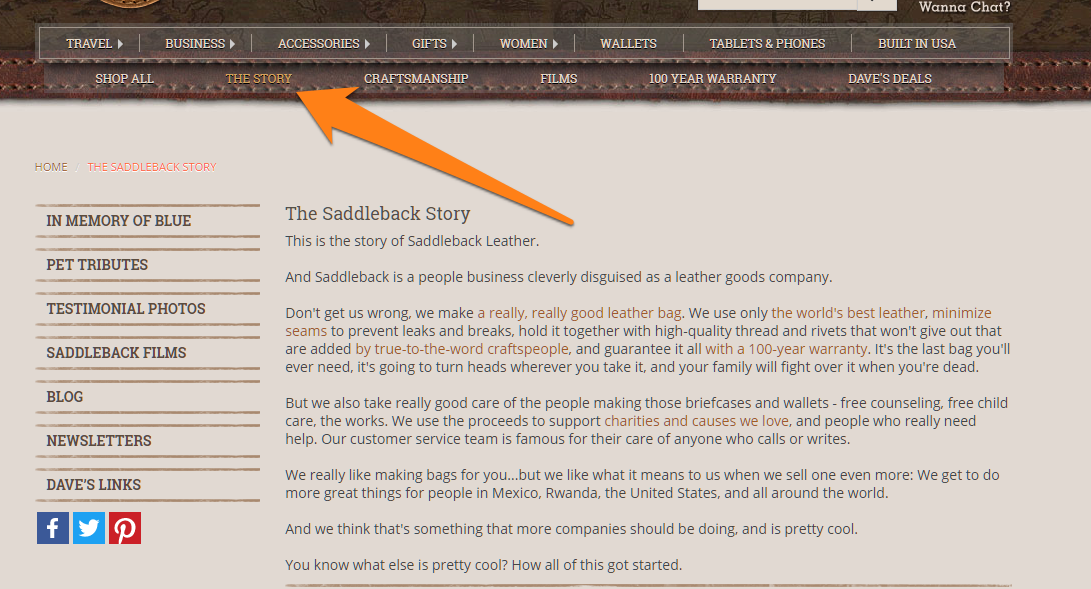
For example, take a look at how Saddleback Leather does it:

6UZUOx4.png

Whatever tactic you use to emphasize your brand’s history and its values, the copy on these pages should reflect your brand.

Key takeaways

Copywriting and conversion rate are inherently related. Good web copy is closely correlated with good conversion rates. Using power words, appropriate formatting, and persona-targeted copywriting can help you drastically improve the copy of your e-commerce website and, by proxy, its conversion rates.

Has your brand made a commitment to enhancing conversion rates with effective copywriting?


Sign up for The Moz Top 10, a semimonthly mailer updating you on the top ten hottest pieces of SEO news, tips, and rad links uncovered by the Moz team. Think of it as your exclusive digest of stuff you don't have time to hunt down but want to read!