The International Energy Agency (IEA) has released its World Energy Outlook (WEO) 2019, providing forecasts of global supply and demand for energy through 2040. The report contains three scenarios:
The Current Policies Scenario forecasts the global energy future when the world continues along its present path, without any additional policy changes.
The Stated Policies Scenario that includes each country’s announced policy intentions and targets.
The Sustainable Development Scenario that forecasts a path that meets sustainable energy goals, aligned with the Paris Climate Agreement, “requiring rapid and widespread changes across all parts of the energy system.”
The agency focuses on the Stated Policies Scenario where energy demand increases by 1 percent per year to 2040.Low-carbon sources supply over half of the new demand, and natural gas supplies a third. Despite these gains towards less carbon-emitting fuels, the expanding global economy and growing population results in slowing increasing carbon dioxide emissions through 2040.
Oil and Natural Gas
Oil demand growth is expected to slow after 2025 and to flatten out in the 2030s, while natural gas demand continues to grow. In the States Policies Scenario, the United States is expected to account for 85 percent of the increase in global oil production to 2030 and for 30 percent of the increase in natural gas production, despite the rate of U.S. production growth slowing in the forecast from its pace in recent years. By 2025, U.S. shale oil and natural gas production is expected to overtake total oil and natural gas production in Russia.
Oil demand for long-distance freight, shipping and aviation, and petrochemicals is expected to increase. IEA expects oil use in passenger cars to peak in the late 2020s due to fuel efficiency improvements and fuel switching, mainly to electricity. Due mostly to projected lower battery costs, electric cars in some markets become cost-competitive, on a total-cost-of-ownership basis, with conventional cars.
Greater U.S. oil production—increasing to 19 million barrels a day by 2030—is expected to decrease the share of the global oil market held by OPEC members and Russia to 47 percent in 2030 from 55 percent in the mid-2000s. Despite the change in market share, the world will still rely heavily on oil supply from the Middle East. The region is expected to remain the largest net provider of oil to world markets and an exporter of LNG. The Strait of Hormuz remains an important artery for global energy trade, especially for Asian countries that rely heavily on imported fuel—80 percent of international oil trade is expected to flow into Asia in 2040, due largely by a doubling of India’s import needs.
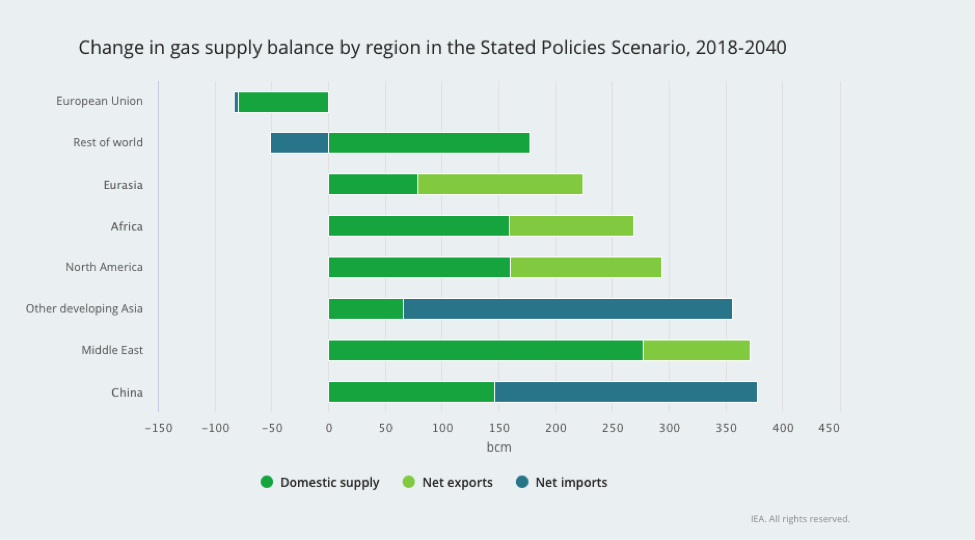
Demand for natural gas has been growing as a fuel for industry and for residential consumers, spurring a worldwide wave of investment in new LNG supply and pipeline connections. IEA expects 70 percent of the increase in Asia’s gas use comes from imports—mostly LNG.
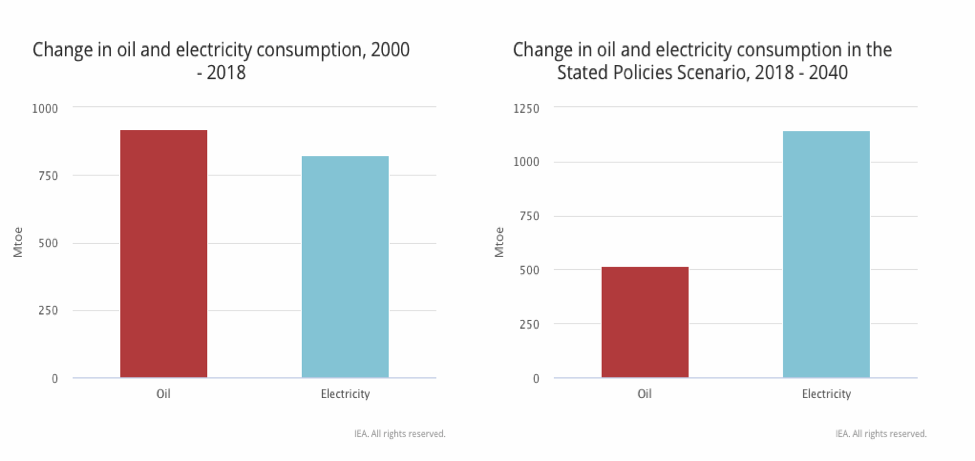
In the Stated Policies Scenario, electricity use grows at over double the pace of overall energy demand. Growth in electricity use is led by industrial motors, mostly in China, followed by household appliances, cooling, and electric vehicles. The share of electricity, less than half that of oil today, is expected to overtake oil by 2040. Wind and solar PV are expected to provide over half of the additional electricity generation to 2040, which enables renewable energy (including hydroelectric) to overtake coal in the global power generation mix in the mid-2020s.
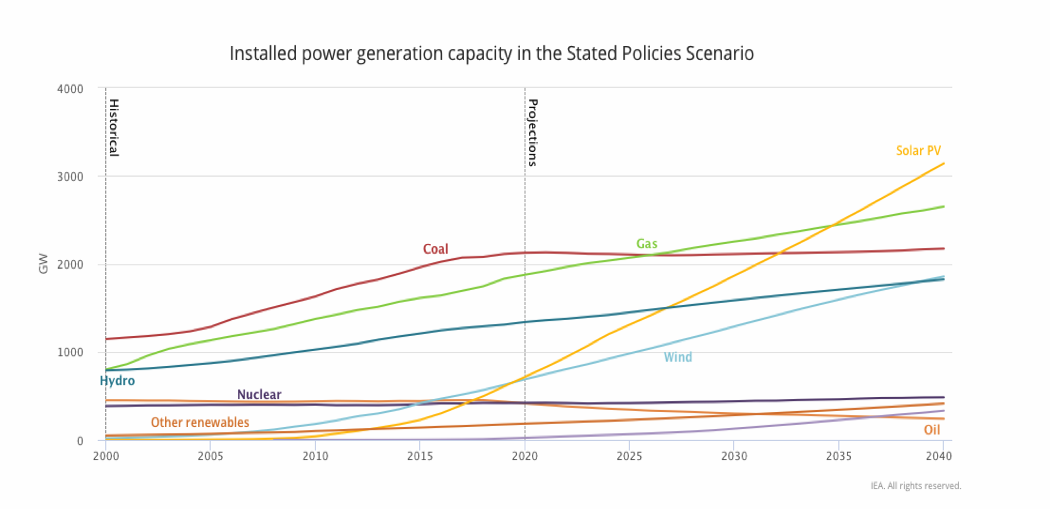
IEA expects solar PV to become the largest component of global installed capacity in the Stated Policies Scenario. By 2040, low-carbon sources provide over half of total electricity generation with hydropower expected to have a 15 percent share of total generation and nuclear providing an 8 percent share.
IEA sees offshore wind expanding due to cost reductions and experience gained in Europe’s North Sea and because it has higher capacity factors than solar PV and onshore wind due to its larger turbine size that reach higher wind speeds offshore. IEA expects offshore wind projects to attract a trillion dollars of global investment to 2040.
Annual electric-vehicle sales are expected to increase to over 30 million in 2040 from 2 million today. The doubling of sales of sport-utility vehicles over the past 10 years is significant to the rate of growth in electric vehicle demand because SUVs are larger, heavier, less fuel-efficient, and harder to electrify. Conventional SUVs consume 25 percent more fuel per kilometer than medium-sized cars. If the popularity of SUVs continues to increase as with recent trends, it could add another 2 million barrels per day to IEA’s projection for 2040 oil demand.
The rate at which battery costs decline is an important variable in forecasting electric car sales. In the Stated Policies Scenario, a major reduction in battery costs is expected to result in about 120 gigawatts of storage installed by 2040.
Conclusion
IEA provides three scenarios to indicate the difference country policy decisions make to the forecasts of the world’s future energy mix and the rate at which a zero-carbon future can be attained. However, neither the Current Policies Scenario nor the Stated Policies Scenario achieve that goal. Besides government policies, other factors that affect the world’s energy future are consumer preferences, technological advancement, and rate of price declines.
It’s that time of year again. Professional development budgets are being distributed and you're daydreaming of Roger hugs and fist bumps. Well, this is a call to arms! It's time to get down to business and convince your boss that you HAVE to go to MozCon 2020.
You're already well acquainted with the benefits of MozCon. Maybe you're a MozCon alumnus. You may have lurked the hashtag once or twice for inside tips and you’ve likely followed the work of some of the speakers for a while. But how are you going to relay that to your boss in a way that sells? Don’t worry, we’ve got a plan.
(And if you want to skip ahead to the letter template, here it is!)
Alright, so just going in and saying “Rand Fishkin is brilliant and have you seen any of Britney Muller’s Whiteboard Fridays lately?!” probably won’t do the trick — we need some cold hard facts that you can present.
MozCon delivers actionable insights
It’s easy to say that MozCon provides actionable insights, but how do you prove it? A quick scroll through our Facebook Group can prove to anyone that not only is MozCon a gathering of the greatest minds in search, but it also acts as an incubator and facilitator for SEO strategies.
If you can’t get your boss on Facebook, just direct them to the blog post written by Croud: Four things I changed immediately after MozCon. Talk about actionable! A quick Google (or LinkedIn) search will return dozens of similar recaps. Gather a few of these to have in your toolbelt just in case.
Or, if you have the time, pick out some of the event tweets from previous years that relate most to your company. The MozCon hashtag (#MozCon) has plenty of tweets to choose from — things like research findings, workflows, and useful tools are all covered. Some of our favorites from last year are listed below.
Attendees are often given access to exclusive tools and betas by the speakers, and that is something you don’t want to miss!
The networking is unbeatable
The potential knowledge gain doesn’t end with keynote speeches. Many of our speakers stick around for the entire conference and host niche- and vertical-specific Birds of a Feather tables over lunch, in addition to attending the networking events. If you find yourself with questions about their strategies, you'll often have the ability to ask them directly.
But the speakers aren’t the only folks worth networking with. We hand-select industry vendors to attend the conference and showcase their products. These vendors are also available for training and showcases throughout the entire conference.
Lastly, your peers! There's no better way to learn than from those who overcome the same obstacles as you. Opportunities for collaboration and peer-to-peer learning are often invaluable (especially those that happen over yummy snacks) and can lead to better workflows, new business, and even exciting partnerships.
Step #2 - Break down the costs
This is where the majority of the conversation will be focused, but fear not, Roger has already done most of the heavy lifting. So let’s cut to the chase. The goal of MozCon isn’t to make money — the goal is to break even and lift up our friends in search.
Top-of-the-line speakers
Every year we work with our speakers to bring cutting-edge content to the stage. You can be sure that the content you’ll be exposed to will set you up for a year of success.
Videos for everyone
While your coworkers won’t be able to enjoy Top Pot doughnuts or KuKuRuZa popcorn, they will be able to see all of the talks via professional video and audio. Your ticket to MozCon includes a professional video package which allows you (and your whole team) to watch every single talk post-conference, for free. (It's a $350 value for the videos alone!)
Good eats
MozCon doesn’t do anything on-par. We strive to go above and beyond in everything we do, and the food options are no exception. MozCon works with local vendors to ensure there are tasty, sustainable meals for everyone, including those with special diets. From breakfast to lunch and all the snacks in-between, MozCon has you covered (and saves your T&E budget a few bucks, as well).
Swag
Not to brag, but our swag is pretty great. Everyone gets their very own special MozCon memorabilia, in addition to other useful and fun items that vary from year to year. Previous gifts include “conference health” fanny packs (complete with Emergen-C!), moleskin notebooks, reusable water bottles, and phone chargers.
Discounts
This is probably the detail that'll make your boss's ears perk up. There are indeed discounts available for MozCon tickets! If you're buying now through January 31st 2020, Early Bird pricing is in effect, which saves you a cool $200 off regular ticket costs. If you've got a team interested in attending, we offer group discounts for parties of 5+ as well. And my final top-secret tip: if your company already subscribes to a Moz product, you can save even more —up to $700 off per regular-priced ticket if you snag Early Bird pricing, or $500 off after January 31st. That's a real chunk of change!
Step #3 - Be prepared to prove value
It’s important to go into the conference with a plan to bring back value. It’s easy to come to any conference and just enjoy the food and company (especially this one), but it’s harder to take the information gained and implement change.
Make a plan
Before approaching your boss, make sure you have a plan on how you're going to show off all of the insights you gather at MozCon! Obviously, you'll be taking notes — whether it’s to the tune of live tweets, bullet journals, or doodles, those notes are most valuable when they're backed up by action.
Putting it into action
Set expectations with your boss. "After each day, I'll select three takeaways and create a plan on how to execute them." Who could turn down nine potential business-changing strategies?!
And it really isn’t that hard! Especially not with the content that you'll have access to. At the close of each day, we recommend you look back over your notes and do a brain-dump.
How did today's content relate to your business?
Which sessions resonated and would bring the most value to your team?
Which strategies can easily be executed?
Which would make the biggest impact?
After you identify those strategies, create a plan of action that will get you on track for implementing change.
(Fun fact — if you're traveling, this can actually be done on the plane ride home!)
Client briefs
If you have clients on retainer, ongoing training for employees is something those clients should appreciate — it ensures you’re staying ahead of the game. Offer to not only debrief your in-house SEO team, but to also present to your clients. This sort of presentation is a value add that many clients don’t get and can set your business apart.
These presentations can be short blurbs at the beginning of a regular meeting or a chance to gather up all of your clients and enjoy a bit of networking and education.
Still not enough?
Give the boss a taste of MozCon by having them check out some videos from years past to get a taste for the caliber of our speakers. And if you're wanting to break into the speaking circuit, you can also take your shot at securing a community speaker spot onstage. Most years, the call for community speakers opens up in early springtime — keep an eye on the Moz Blog for your chance to pitch!
Lastly, the reviews speak for themselves. MozCon is perfect for SEOs of any level and we even factor in time for you to get a little work done in-between sessions — Vaneese can tell you!
Our fingers are crossed!
Alright friend, now is your time to shine. We've equipped you with some super-persuasive tools and we'll be crossing our fingers that the boss gives you the "okay!" Be sure to grab the letter template and make your case the easy way:
If you can make it, we promise to spoil you to the tune of endless Starbucks coffee, tons of new friends, and an experience that will change your perspective on search. We hope to see your smiling face at MozCon 2020!
Sign up for The Moz Top 10, a semimonthly mailer updating you on the top ten hottest pieces of SEO news, tips, and rad links uncovered by the Moz team. Think of it as your exclusive digest of stuff you don't have time to hunt down but want to read!
Are you interested in being part of the global energy transition to renewables and participating in a two-year masters’ program? Western Colorado University’sMaster in Environmental Management (MEM) has partnered with Solar Energy International (SEI) to create a master in environmental management degree that integrates SEI training with MEM program courses for students interested in doing their 600+ hour second year project with SEI and providing up to 10 hours a week of internship work during their first year. Access to affordable, reliable energy is key to providing a just and sustainable pathway to economic development and opportunity globally.
Western Colorado University seeks applicants for their program who will complete projects that empower people in the United States and/or throughout the world. Fellows will receive a $5,000 fellowship to be applied toward their master’s tuition across their two years and up to a $5,000 fellowship from SEI to be applied toward SEI courses (E.g, PV101, 203, 201L and up to two other courses based on project interest and course availability).
Texas Tech climate scientist Katharine Hayhoe had a recent article in the NYT in which she argued that her being an evangelical Christian didn’t conflict with her day job. Even though American evangelicals are overwhelmingly conservative in their political views—and hence are not the biggest fans of Al Gore or Greta Thunberg—Hayhoe took to the newspaper to announce, “I’m Canadian, which is why it took me so long to realize [being an evangelical and a climate scientist] were supposed to be entirely incompatible.”
As it so happens, I’m also an evangelical Christian, and I disagree quite strongly with the government policies that Hayhoe (and the groups whom she advises) favor in the name of fighting climate change. And yet, this isn’t because I reject “the science.” Although I believe Hayhoe’s anecdotes of shabby treatment she received on social media, it is intellectually lazy to dismiss any such criticism as people who place faith over reason. It’s precisely because I’ve read the IPCC’s periodic reports—as well as the broader peer-reviewed economics literature—that I know Hayhoe and many of her colleagues are giving the public a misleading synopsis when it comes to climate change.
In a nutshell: “The science” does not conclude that governments around the world must enact drastic mitigation measures in order to avert catastrophe. It would be convenient for Dr. Hayhoe if all the scientists agreed with her and only religious fanatics raised objections, but that’s not at all the situation.
Lobbing Exaggerated Objections Against American Christians
Here’s how Hayhoe describes the attitude of American evangelicals when it comes to climate science:
I realized, distantly, that there were people on both “sides” who fundamentally believed and were even dedicated to promoting the idea that faith and science were in conflict. But it wasn’t until after I’d moved to the United States for graduate school that it dawned on me, to my disbelief, that divisions within the science-faith arena, originally focused on questions of human origins and the age of the universe, were expanding to include climate change.
Now, this discrepancy is pointed out to me nearly every day: often by people with Bible verses in their social media profiles who accuse me of spreading Satan’s lies, or sometimes by others who share my concerns about climate change but wonder why I bother talking to “those people.”
To reiterate, I don’t deny that some hotheads may have tweeted nasty things at Dr. Hayhoe, even while their Twitter profile announces their allegiance to the Prince of Peace. They should have been nicer, and maybe next time they should ask “What would Jesus tweet?” before firing off a zinger.
In any event, it’s simply not the case that there is a fundamental schism between religious faith and scientific inquiry—even though this myth has been pushed often by secular science supporters. For one thing, some of history’s greatest scientists were religious, including giants like Isaac Newton and even Galileo (who plays such a pivotal role in the alleged Church/science divide). Back in 2005 the NYT itself ran a piece discussing a 1997 survey of American scientists and mathematicians in which 40 percent said they believed in God.
What makes Hayhoe’s essay exasperating is that one of the leading climate science “skeptics”—namely, Dr. Roy Spencer—is himself a Bible-believing Christian. And irony of ironies, Spencer’s “denialist” views on climate change—even though he is a peer-reviewed researcher who headed a project at NASA and won an award from the American Meteorological Society—are often rejected out of hand because of his “irrational” faith. So although Hayhoe’s essay garners sympathy for the apparent assault she receives from skeptical evangelists, she should appreciate that Roy Spencer gets hammered from the opposite angle by agnostic believers in catastrophic climate change.
Furthermore, does Hayhoe really think that if Dr. Roy Spencer gave a quick talk at a church picnic about his work on climate change, that the evangelicals would start booing him to shut up with all that pointy-headed devil talk? Of course not. This consideration demonstrates that the evangelicals who may oppose Hayhoe’s work aren’t doing so because they reject “science” per se, but because they reject the political conclusions that she (and more vocally, those whom she advises) draws from it.
Bible-Believing Christians Want to Help the World’s Poor—Which Is Why They Support Affordable Energy
Indeed, it should be obvious to Hayhoe that this alleged dichotomy between faith and climate science is bogus, because there is an entire organization—the Cornwall Alliance for the Stewardship of Creation—that proudly marries Christian doctrine with a free-market approach to climate change policy. As its website explains:
The Cornwall Alliance is a network of evangelical Christian scholars–mostly natural scientists, economists, policy experts, theologians, philosophers, and religious leaders–dedicated to educating the public and policymakers about Biblical earth stewardship (men and women working together to enhance the fruitfulness, beauty, and safety of the earth, to the glory of God and the benefit of our neighbors), economic development for the poor (through private property rights, entrepreneurship, free trade, limited government, the rule of law, and access to abundant, affordable, reliable energy), and the gospel of forgiveness of sins and reconciliation with God by grace through faith in the atoning death and vindicating resurrection of Jesus Christ.
It’s surprising that Hayhoe would write an entire essay lamenting that American evangelicals reject climate science, without mentioning the Cornwall Alliance. Maybe she never heard of them, but e.g. this 2014 Guardian article quotes Hayhoe in order to reassure its readers just how wrong the Cornwall folks are.
In summary, no Dr. Hayhoe, the average American evangelical who (for example) supports President Trump pulling out of the Paris Agreement isn’t doing so because he rejects “science.” It’s because he is very skeptical of people pushing through a dubious political agenda smuggled in illegitimately under the label of “consensus.”
As I have documented many times here at IER over the years, the peer-reviewed literature does not support the aggressive political agenda being foisted on Americans in the name of climate change. For a simple example that I have often cited: William Nordhaus won the Nobel Prize for his work on the economics of climate change on the same weekend that the IPCC released its guide for limiting global warming to 1.5 degrees Celsius. And yet, Nordhaus’ own work shows that governments doing nothing would be better for human welfare than trying to achieve the UN’s ambitious goal.
Who’s Driven By Fear?
Later in her essay, Hayhoe’s patronizing handling of her critics reaches absurdity:
After hundreds, even thousands, of such conversations, I’ve grown to understand how much of this opposition to the idea that the climate is changing, that humans are responsible, that the impacts are serious and that the time to act is now, comes from fear: fear of loss of our way of life, fear of being told that our habits are bad for society, fear of changes that will leave us worse off, fear of siding with those who have no respect for our values and beliefs.
But as a Christian, I believe the solution to this fear lies in the same faith that many non-Christians wrongly assume drives our rejection of the science.
This is simply too rich. We have prominent political figures warning that humans have twelve years—or more like eleven, at this point—to act or else “the world is going to end,” and that “life on earth is at risk.” And it’s those skeptical of such politicians who are driven by fear? Hayhoe should step back and consider the big picture here, before dismissing her opponents with such a glib psychoanalysis.
Extreme Environmentalism as Religion
Hayhoe takes the science/religion dichotomy in a different way when she writes:
An important and successful part of that framing has been to cast climate change as an alternate religion. This is sometimes subtle, as the church sign that reads, “On Judgment Day, you’ll meet Father God not Mother Earth.” Other times this point is made much more blatantly, like when Senator Ted Cruz of Texas told Glenn Beck in 2015 that “climate change is not a science, it’s a religion,” or when Senator Lindsey Graham of South Carolina said at a 2014 event hosted by the Council on Foreign Relations that “the problem is Al Gore’s turned this thing into a religion.”
Why is this framing so effective? Because some 72 percent of people in the United States already identify with a specific religious label, according to a recent survey by the Pew Research Center. And if you are a Christian, you know what to do when a false prophet comes along preaching a religion that worships the created rather than the Creator: Reject it!
In the first place, it’s a bit odd that Hayhoe originally said that American conservatives rejected climate science because their own religion (evangelical Christianity) doesn’t like science, but now she is quoting people who reject it because it’s not science, and instead is a religion. So which is it, Dr. Hayhoe? Are American critics so confused that they think the climate change agenda is both a science and a religion at the same time? (I’m tempted to make a crack about Schrödinger’s cat, but I’m afraid a physics joke might weaken my religious credentials.)
Here’s what’s going on: Generally speaking, American conservatives, regardless of their specific views on the Bible, respect religion and they respect science. They don’t think there is any conflict at all between the two. As I already argued, some of history’s greatest scientists believed in God, and indeed thought science itself rested on a belief in the underlying order of Nature—which after all, has no reason to be orderly in and of itself.
Yet even though American conservatives respect both religion and science, and don’t think there is an inherent conflict between the two, properly understood, they also understand that they are distinct fields. And they can see what is obvious to anyone with eyes to see: The most aggressive activists in the climate change debate—including many of the leading scientists—are acting in a very un-scientific way.
If one physicist says, “I don’t believe in dark matter as a useful hypothesis,” other physicists will debate him on the matter. But they won’t call him a “denier” for daring to deviate from his peers, devote entire websites to smearing his reputation, and have secret email discussions about redefining the physics literature to prevent the public from seeing his published papers. Yet this is standard operating procedure in “climate science.”
As a final point on this issue: It’s not just cynical Republicans saying that in practice, climate activists have turned the science into religion. Just a couple of weeks ago, Hawaii’s Democratic Sen. Mazie Hirono said the same thing, but meant it as a good thing.
Conclusion
As a Christian, I recognize a duty to help the world’s poor. Given their track record for horrible economic policies (not to mention mass bombing campaigns), I don’t think the world’s governments are the best vehicle for trying to help the disadvantaged. It’s true that American evangelicals don’t buy the standard narrative on climate change being pushed by political figures and the corporate media, but that’s not because they reject “science.” On the contrary, it’s because they follow dissident scientists (and other experts) who point out the dishonesty in the campaign.
The Bible instructs us to aid the poor and steward creation, but it also teaches humility. The NYT itself recently published an article from a PhD physicist saying that for all we know, climate change might be merely an inconvenience—we need faster supercomputers to have a better idea. Anyone telling you otherwise, namely that “the science is settled” and that we know humans “have to act now,” suffers from the deadly sin of pride.
Reporting fake and duplicate listings to Google sounds hard. Sometimes it can be. But very often, it’s as easy as falling off a log, takes only a modest session of spam fighting and can yield significant local ranking improvements.
If your local business/the local brands your agency markets aren’t using spam fighting as a ranking tactic because you feel you lack the time or skills, please sit down with me for a sec.
What if I told you I spent about an hour yesterday doing something that moved a Home Depot location up 3 spots in a competitive market in Google’s local rankings less than 24 hours later? What if, for you, moving up a spot or two would get you out of Google’s local finder limbo and into the actual local pack limelight?
Today I’m going to show you exactly what I did to fight spam, how fast and easy it was to sweep out junk listings, and how rewarding it can be to see results transform in favor of the legitimate businesses you market.
Who knew that shopping for window coverings would lead me into a den of spammers throwing shade all over Google?
The story of Google My Business spam is now more than a decade in the making, with scandalous examples like fake listings for locksmiths and addiction treatment centers proving how unsafe and unacceptable local business platforms can become when left unguarded.
But even in non-YMYL industries, spam listings deceive the public, waste consumers’ time, inhibit legitimate businesses from being discovered, and erode trust in the spam-hosting platform. I saw all of this in action when I was shopping to replace some broken blinds in my home, and it was such a hassle trying to find an actual vendor amid the chaff of broken, duplicate, and lead gen listings, I decided to do something about it.
I selected an SF Bay area branch of Home Depot as my hypothetical “client.” I knew they had a legitimate location in the city of Vallejo, CA — a place I don’t live but sometimes travel to, thereby excluding the influence of proximity from my study. I knew that they were only earning an 8th place ranking in Google’s Local Finder, pushed down by spam. I wanted to see how quickly I could impact Home Depot’s surprisingly bad ranking.
I took the following steps, and encourage you to take them for any local business you’re marketing, too:
Step 1: Search
While located at the place of business you’re marketing, perform a Google search (or have your client perform it) for the keyword phrase for which you most desire improved local rankings. Of course, if you’re already ranking well as you want to for the searchers nearest you, you can still follow this process for investigating somewhat more distant areas within your potential reach where you want to increase visibility.
In the results from your search, click on the “more businesses” link at the bottom of the local pack, and you’ll be taken to the interface commonly called the “Local Finder.”
The Local Finder isn’t typically 100% identical to the local pack in exact ranking order, but it’s the best place I know of to see how things stand beyond the first 3 results that make up Google’s local packs, telling a business which companies they need to surpass to move up towards local pack inclusion.
Find yourself in the local finder. In my case, the Home Depot location was at position 8. I hope you’re somewhere within the first set of 20 results Google typically gives, but if you’re not, keep paging through until you locate your listing. If you don’t find yourself at all, you may need to troubleshoot whether an eligibility issue, suspension, or filter is at play. But, hopefully that’s not you today.
Next, create a custom spreadsheet to record your findings. Or, much easier, just make a copy of mine!
Populate the spreadsheet by cutting and pasting the basic NAP (name, address, phone) for every competitor ranking above you, and include your own listing, too, of course! If you work for an agency, you’ll need to get the client to help you with this step by filling the spreadsheet out based on their search from their place of business.
In my case, I recorded everything in the first 20 results of the Local Finder, because I saw spam both above and below my “client,” and wanted to see the total movement resulting from my work in that result set.
Step 3: Identify obvious spam
We want to catch the easy fish today. You can go down rabbit holes another day, trying to ferret out weirdly woven webs of lead gen sites spanning the nation, but today, we’re just looking to weed out listings that clearly, blatantly don’t belong in the Local Finder.
Go through these five easy steps:
Look at the Google Streetview image for each business outranking you.
Do you see a business with signage that matches the name on the listing? Move on. But if you see a house, an empty parking lot, or Google is marking the listing as “location approximate”, jot that down in the Notes section of your spreadsheet. For example, I saw a supposed window coverings showroom that Streetview was locating in an empty lot on a military base. Big red flag there.
Make note of any businesses that share an address, phone number, or very similar name.
Make note of anything with an overly long name that seems more like a string of keywords than a brand. For example, a listing in my set was called: Custom Window Treatments in Fairfield, CA Hunter Douglas Dealer.
For every business you noted down in steps one and two, get on the phone.
Is the number a working number? If someone answers, do they answer with the name of the business? Note it down. Say, “Hi, where is your shop located?” If the answer is that it’s not a shop, it’s a mobile business, note that down. Finally, If anything seems off, check the Guidelines for representing your business on Google to see what’s allowed in the industry you’re investigating. For example, it’s perfectly okay for a window blinds dealer to operate out of their home, but if they’re operating out of 5 homes in the same city, it’s likely a violation. In my case, just a couple of minutes on the phone identified multiple listings with phone numbers that were no longer in service.
Visit the iffy websites.
Now that you’re narrowing your spreadsheet down to a set of businesses that are either obviously legitimate or “iffy,” visit the websites of the iffy ones. Does the name on the listing match the name on the website? Does anything else look odd? Note it down.
Highlight businesses that are clearly spammy.
Your dive hasn’t been deep, but by now, it may have identified one or more listings that you strongly believe don’t belong because they have spammy names, fake addresses, or out-of-service phone numbers. My lightning-quick pass through my data set showed that six of the twenty listings were clearly junk. That’s 30% of Google’s info being worthless! I suggest marking these in red text in your spreadsheet to make the next step fast and easy.
Step 4: Report it!
If you want to become a spam-fighting ace later, you’ll need to become familiar with Google’s Business Redressal Complaint Form which gives you lots of room for sharing your documentation of why a listing should be removed. In fact, if an aggravating spammer remains in the Local Finder despite what we’re doing in this session, this form is where you’d head next for a more concerted effort.
But, today, I promised the easiness of falling off a log, so our first effort at impacting the results will simply focus on the “suggest an edit” function you’ll see on each listing you’re trying to get rid of. This is how you do it:
After you click the “suggest an edit” button on the listing, a popup will appear. If you’re reporting something like a spammy name, click the “change name or other details” option and fill out the form. If you’ve determined a listing represents a non-existent, closed, unreachable, or duplicate entity, choose the “remove this place” option and then select the dropdown entry that most closely matches the problem. You can add a screenshot or other image if you like, but in my quick pass through the data, I didn’t bother.
Record the exact action you took for each spam listing in the “Actions” column of the spreadsheet. In my case, I was reporting a mixture or non-existent buildings, out-of-service phone numbers, and one duplicate listing with a spammy name.
Finally, hit the “send” button and you’re done.
Step 5: Record the results
Within an hour of filing my reports with Google, I received an email like this for 5 of the 6 entries I had flagged:
The only entry I received no email for was the duplicate listing with the spammy name. But I didn’t let this worry me. I went about the rest of my day and checked back in the morning.
I’m not fond of calling out businesses in public. Sometimes, there are good folks who are honestly confused about what’s allowed and what isn’t. Also, I sometimes find screenshots of the local finder overwhelmingly cluttered and endlessly long to look at. Instead, I created a bare-bones representational schematic of the total outcome of my hour of spam-fighting work.
The red markers are legit businesses. The grey ones are spam. The green one is the Home Depot I was trying to positively impact. I attributed a letter of the alphabet to each listing, to better help me see how the order changed from day one to day two. The lines show the movement over the course of the 24 hours.
The results were that:
A stayed the same, and B and C swapping positions was unlikely due to my work; local rankings can fluctuate like this from hour to hour.
Five out of six spam listings I reported disappeared. The keyword-stuffed duplicate listing which was initially at position K was replaced by the brand’s legitimate listing one spot lower than it had been.
The majority of the legitimate businesses enjoyed upward movement, with the exception of position I which went down, and M and R which disappeared. Perhaps new businesses moving into the Local Finder triggered a filter, or perhaps it was just the endless tide of position changes and they’ll be back tomorrow.
Seven new listings made it into the top 20. Unfortunately, at a glance, it looked to me like 3 of these new listings were new spam. Dang, Google!
Most rewardingly, my hypothetical client, Home Depot, moved up 3 spots. What a super easy win!
Fill out the final column in your spreadsheet with your results.
What we’ve learned
You battle upstream every day for your business or clients. You twist yourself like a paperclip complying with Google’s guidelines, seeking new link and unstructured citation opportunities, straining your brain to shake out new content, monitoring reviews like a chef trying to keep a cream sauce from separating. You do all this in the struggle for better, broader visibility, hoping that each effort will incrementally improve reputation, rankings, traffic, and conversions.
Catch your breath. Not everything in life has to be so hard. The river of work ahead is always wide, but don’t overlook the simplest stepping stones. Saunter past the spam listings without breaking a sweat and enjoy the easy upward progress!
I’d like to close today with three meditations:
1. Google is in over their heads with spam
Google is in over their heads with spam. My single local search for a single keyword phrase yielded 30% worthless data in their top local results. Google says they process 63,000 searches per second and that as much as 50% of mobile queries have a local intent. I don’t know any other way to look at Google than as having become an under-regulated public utility at this point.
Expert local SEOs can spot spam listings in query after query, industry after industry, but Google has yet to staff a workforce or design an algorithm sufficient to address bad data that has direct, real-world impacts on businesses and customers. I don’t know if they lack the skills or the will to take responsibility for this enormous problem they’ve created, but the problem is plain. Until Google steps up, my best advice is to do the smart and civic work of watchdogging the results that most affect the local community you serve. It’s a positive not just for your brand, but for every legitimate business and every neighbor near you.
2. You may get in over your head with spam
You may get in over your head with spam. Today’s session was as simple as possible, but GMB spam can stem from complex, global networks. The Home Depot location I randomly rewarded with a 3-place jump in Local Finder rankings clearly isn’t dedicating sufficient resources to spam fighting or they would’ve done this work themselves.
But the extent of spam is severe. If your market is one that’s heavily spammed, you can quickly become overwhelmed by the problem. In such cases, I recommend that you:
Read this excellent recent article by Jessie Low on the many forms spam can take, plus some great tips for more strenuous fighting than we’ve covered today.
Follow Joy Hawkins, Mike Blumenthal, and Jason Brown, all of whom publish ongoing information on this subject. If you wade into a spam network, I recommend reporting it to one or more of these experts on Twitter, and, if you wish to become a skilled spam fighter yourself, you will learn a lot from what these three have published.
If you don’t want to fight spam yourself, hire an agency that has the smarts to be offering this as a service.
You can also report listing spam to the Google My Business Community Forum, but it’s a crowded place and it can sometimes be hard to get your issue seen.
What if you built a local movement? What if you and your friendlier competitors joined forces to knock spam out of Google together? Imagine all of the florists, hair salons, or medical practitioners in a town coming together to watch the local SERPs in shifts so that everyone in their market could benefit from bad actors being reported.
Maybe you’re already in a local business association with many hands that could lighten the work of protecting a whole community from unethical business practices. Maybe your town could then join up with the nearest major city, and that city could begin putting pressure on legislators. Maybe legislators would begin to realize the extent of the impacts when legitimate businesses face competition from fake entities and illegal practices. Maybe new anti-trust and communications regulations would ensue.
Now, I promised you “simple,” and this isn’t it, is it? But every time I see a fake listing, I know I’m looking at a single pebble and I’m beginning to think it may take an avalanche to bring about change great enough to protect both local brands and consumers. Google is now 15 years into this dynamic with no serious commitment in sight to resolve it.
At least in your own backyard, in your own community, you can be one small part of the solution with the easy tactics I’ve shared today, but maybe it’s time for local commerce to begin both doing more and expecting more in the way of protections.
I’m ready for that. And you?
Sign up for The Moz Top 10, a semimonthly mailer updating you on the top ten hottest pieces of SEO news, tips, and rad links uncovered by the Moz team. Think of it as your exclusive digest of stuff you don't have time to hunt down but want to read!
Misleading foundations and charities now fund extreme environmental groups focused on disrupting America’s reliable energy sources
WASHINGTON DC (December 2, 2019) – The Institute for Energy Research (IER) is announcing another update to its Big Green, Inc. database, along with a caution to American citizens and companies poised to open their wallets tomorrow on Giving Day, a day dedicated to promoting charitable giving.
Today’s Big Green, Inc. update focuses on 1,583 grants made from three highly visible foundations – the Heinz Foundation, Bloomberg Family Foundation, and Kresge Foundation – which are clearly helping to fuel the environmental lobby and its efforts to restrict affordable, reliable energy. Between 2008 and 2016, these three foundations funded 513 environmental groups—many of which hold anti-energy biases—across the United States with grants totaling $473,207,264.
To date, the Big Green, Inc. database now tracks environmental grants stemming from 17 foundations and directed to 2,210 grassroots activist groups totaling $4,689,130,216.
IER President Thomas Pyle made the following statement:
“It’s becoming more and more clear that today’s environmental movement is fueled by a group of interconnected, left-leaning foundations that are seeking to disrupt the development of America’s energy resources. Despite what some seemingly local, environmental non-profits may claim, they are merely front groups bankrolled by elitist billionaires who care more about their own financial interests than saving the planet.”
“I would caution anyone thinking about donating to a foundation or charity on Giving Tuesday to run a search in our database first. You will see that many green groups are not what they appear to be. It’s a bit unfair, if not disingenuous, for so few in the press to ask or explain to readers the deceitful connection between foundations and these extreme environmental groups.”
About Big Green, Inc.
Big Green, Inc. is a project of IER that demonstrates money’s influence on energy policy in the United States. The online map enables users to navigate the various foundations that spend billions of dollars supporting aggressive climate litigation, the promotion of uneconomic renewable energy sources, and overburdening regulations. Their money has helped foment the anti-market sentiment that dominates energy policy in the United States and has played a major role in limiting economic growth in recent years.
Overview of latest additions to Big Green, Inc.
The Heinz Endowments, a philanthropic organization based in Pittsburgh, Pennsylvania, focuses much of its environmental grantmaking efforts on projects opposing natural gas and coal development. The endowments granted over $120 million to a variety of environmental public engagement initiatives and regulatory campaigns during the evaluated period. The Heinz Endowments primarily funds projects in the city of Pittsburgh and its surrounding area of western Pennsylvania—a region that was built on heavy industry and continues to benefit from its bountiful natural resources and prodigious energy production. Though the projects are often ostensibly in support of worthy causes, like local air quality, many of the grant recipients work to stymie the industries that comprise the community’s backbone.
The Bloomberg Family Foundation, founded in 2006, is a $7 billion entity started by former New York City mayor Michael Bloomberg. The Bloomberg Family Foundation’s environmental grantmaking focuses on high dollar donations to large environmental organizations and movements, including millions of dollars in donations to the Beyond Coal Campaign. The foundation has also awarded multi-million dollar grants to the Sierra Club, the Energy Foundation, the Environmental Defense Fund, and other large national far left environmental groups. The sum during the evaluated period exceeded $130 million.
The Kresge Foundation, a Michigan-based philanthropic organization, outdid both the Heinz Endowments and the Bloomberg Family Foundation during the evaluated period in terms of raw dollar contributions to environmental entities, with grants exceeding $200 million. Kresge writes environmental grants mainly to fund projects related to climate change mitigation, efficient building practices and standards, and reducing transportation-related pollution. Additionally, however, Kresge funneled millions of dollars toward ambiguous climate change and energy efficiency policy initiatives that undoubtedly supported efforts to limit energy freedom. The Kresge Foundation’s partners are nationwide, but grants were especially frequent in Michigan, New England, and the Pacific Northwest.
Three important takeaways from the information presented in Big Green, Inc.
1. Environmental groups have crafted a narrative that depicts their efforts as a “David vs. Goliath” battle against those who would like to see U.S. energy policy move in a free-market direction. This narrative is false. Environmental groups outpace conservative and free-market groups both in terms of funding and organizational capacity.
2. There is an overwhelming, well-coordinated and deeply funded sweeping influence of environmental activism and information within this database provides insight into how groups target the gatekeeping institutions of our society. As the database illuminates, environmental funding has been directed toward policymakers, journalists, academic institutions, the offices of elected officials, government organizations like the Federal Emergency Management Agency, as well as international institutions such as the World Bank.
3. This complicated system of financial transfers muddles efforts to reveal the sources of this funding, which has been linked to individuals who stand to benefit financially from the adoption of various environmental policies as well as foreign actors trying to influence energy policy within the U.S.
Today the Institute for Energy Research is announcing the release of an update to its Big Green, Inc. database, a project that seeks to shine a light on the whopping sums of money quietly fueling the national environmental lobby and its efforts to restrict affordable, reliable energy.
We have added three new left-leaning, grantmaking organizations to the Big Green, Inc. database. This update covers 1,583 grants originating from the Heinz Endowments, the Bloomberg Family Foundation, and the Kresge Foundation. Between 2008 and 2016, these three foundations funded 513 environmental groups—many of which hold anti-energy biases—across the United States with grants totaling $473,207,264.
The Heinz Endowments, a philanthropic organization based in Pittsburgh, Pennsylvania, focuses much of its environmental grantmaking effort on projects opposing natural gas and coal development. The endowments granted over $120 million to a variety of environmental public engagement initiatives and regulatory campaigns during the evaluated period. The Heinz Endowments primarily funds projects in the city of Pittsburgh and its surrounding area of western Pennsylvania—a region that was built on heavy industry and continues to benefit from its bountiful natural resources and prodigious energy production. Though the projects are often ostensibly in support of worthy causes, like local air quality, many of the grant recipients work to stymie the industries that comprise the community’s backbone.
The Bloomberg Family Foundation, founded in 2006, is a $7 billion entity started by former New York City mayor Michael Bloomberg. The Bloomberg Family Foundation’s environmental grantmaking focuses on high dollar donations to large environmental organizations and movements, including millions of dollars in donations to the Beyond Coal Campaign. The foundation has also awarded multi-million dollar grants to the Sierra Club, the Energy Foundation, the Environmental Defense Fund, and other large, national, far-left environmental groups. The sum during the evaluated period exceeded $130 million.
The Kresge Foundation, a Michigan-based philanthropic organization, outdid both the Heinz Endowments and the Bloomberg Family Foundation during the evaluated period in terms of raw dollar contributions to environmental entities, with grants exceeding $200 million. Kresge writes environmental grants mainly to fund projects related to climate change mitigation, efficient building practices and standards, and reducing transportation-related pollution. Additionally, however, Kresge funneled millions of dollars toward ambiguous climate change and energy efficiency policy initiatives that undoubtedly supported efforts to limit energy freedom. The Kresge Foundation’s partners are nationwide, but grants were especially frequent in Michigan, New England, and the Pacific Northwest.
This update offers the public a window into the activities of three key cogs in the vast energy obstruction network we call Big Green, Inc.