Kenny Stein, IER’s Policy Director, joins the show to discuss the 555-page energy bill recently introduced in the senate. Kenny provides an overview of the bill’s major features as it currently stands and explores the impacts of potential amendments.
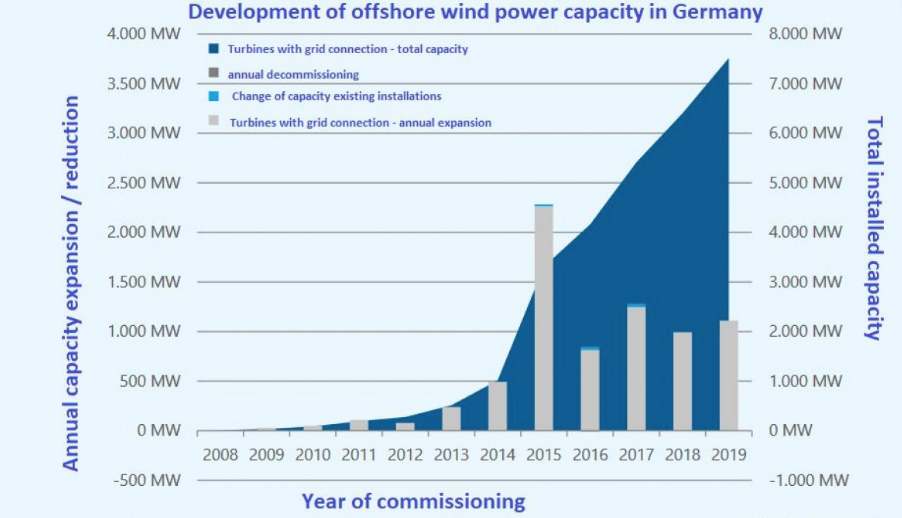
Last year, new offshore wind power capacity in Germany exceeded that of onshore wind capacity for the first time. In 2019, 160 new offshore wind turbines with a combined capacity of 1.1 gigawatts began feeding into the grid. The number of turbines in the German North Sea and Baltic Sea reached nearly 1,500, with installed capacity over 7.5 gigawatts, almost fulfilling the government’s 2020 target ahead of schedule. Generating over 25 terawatt-hours of electricity, offshore turbines contributed about four percent to Germany’s gross power consumption. The 2019 offshore capacity addition compares to 0.9 gigawatts of new onshore turbines (276 turbines) added in 2019. Thousands of planned onshore wind projects in Germany are currently on hold, due to regulatory conflicts with aviation authorities and protest groups challenging new installations in court. Since 2016, permits for new onshore turbine installations fell by 70 percent. Germans have to date displayed a harsh political reaction to their electricity prices, which are among the highest in Europe and about three times as expensive as U.S. residential rates.
But, the offshore wind industry in Germany is now worried that market rates will be insufficient to cover costs without subsidies. The first time Germany auctioned offshore wind projects, developers were confident that the technology was robust enough to turn a profit without subsidies. Now Germany’s offshore wind developers are asking the government to institute a U.K.-like program that would ensure they get paid enough for their power, no matter what wholesale prices are doing. The U.K. government offers agreements called contracts-for-difference, or CfDs, to promote the technology, which locks in the price of power generated by new projects.
Offshore wind developers want the financial guarantee because they are concerned about the government’s climate policymaking investments in the technology riskier. For instance, developers were surprised at Angela Merkel’s 2018 decision to raise Germany’s 2030 clean power target to 65 percent from 55 percent, which will require more investments in generation, transmission, and storage.
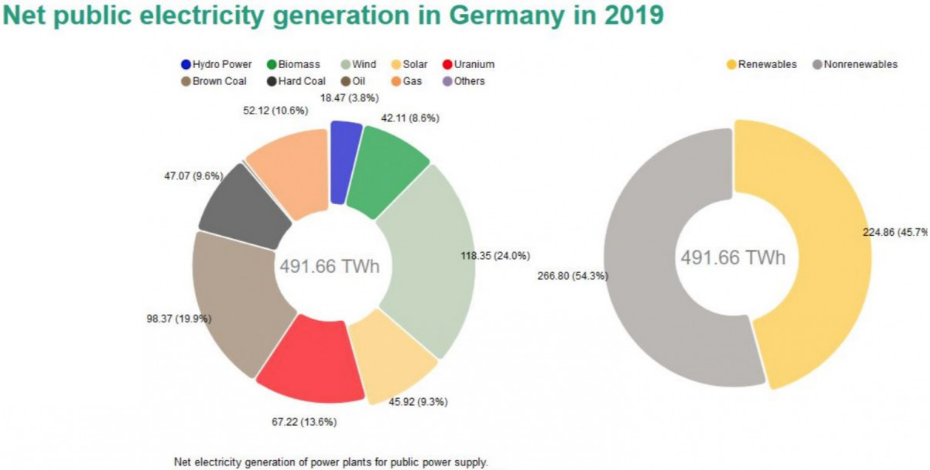
Onshore and offshore wind power installations generated nearly one-quarter of Germany’s total electricity production in 2019, relegating lignite (brown coal) to second place. In 2019, Germany’s offshore wind sector increased its power output by 25 percent. In the next few years, about 9.2 gigawatts of German offshore capacity are expected to be auctioned. The German government announced that it would be increasing the goal for offshore wind in 2030 from 15 to 20 gigawatts capacity in its climate action package. Germany has the potential to build up to 50 gigawatts of offshore wind power, despite its limited coastline.
But the country’s onshore wind industry is having major problems and there are fears that it may face the same fate as the country’s solar panel manufacturers. Year-on-year expansion of Germany’s onshore turbine capacity dropped by 80 percent, leading to warnings by industry that a persisting slump would have severe consequences for business and employment, with over a quarter of all wind power jobs at risk. The problems stem from stalled licensing procedures due to concerns by aviation authorities and other official bodies and because of lawsuits by citizens protesting against construction near their homes and environmental organizations blocking installations due to species conservation. Turbine manufacturer Senvion declared its insolvency in early 2019 and Germany’s market leader Enercon announced it would have to slash thousands of jobs due to declining business.
With Germany’s last nuclear power plant to be shuttered in 2022 and coal power to be phased out no later than 2038, Germany plans to get 65% of its power from wind, solar, and other renewable sources by 2030. Originally, Germany used feed-in tariffs as the mechanism to encourage renewable energy development, which was introduced under the Renewable Energy Act in 2000, and guaranteed for 20 years, but the country changed its approach putting caps on annual expansion, and having power producers compete in auctions for a share of each year’s new capacity.
About 4 gigawatts of capacity will no longer be eligible for renewable feed-in tariff support after next year. Power purchase agreements will be used to keep older turbines operable and are projected to play an increasing role in future renewables deployment. A power purchase agreement is a contract between a power generator and an electricity consumer specifying the terms for the sale of electricity. Other ideas being considered by the government and industry to assuage wind power opponents include improved financial participation by granting residents lower power price tariffs, providing green power directly to local businesses, or paying municipalities a dividend of the profits generated with the turbines.
Conclusion
Wind power became Germany’s single most important power source in 2019. Nevertheless, expansion numbers of onshore wind have collapsed due to regulatory issues and lawsuits by citizens and environmental organizations. While turbine manufacturers worry that more jobs will be lost and Germany’s renewable power targets missed due to lacking onshore expansion, offshore wind power is establishing itself as a cornerstone of the country’s future energy supply. But, developers of offshore wind power want to be assured by the government that they face no (or little) financial risk. Clearly, Germany is breaking new ground given its already high electricity prices and its plans to drastically increase renewable energy for its electricity needs. Policymakers should keep a close eye on what develops out of Germany’s experiment with “green power.”
You’ve produced a piece of content you thought was going to be a huge success, but the results were underwhelming.
You double and triple checked the content for all the crucial elements: it’s newsworthy, data-driven, emotional, and even a bit controversial, but it failed to “go viral”. Your digital PR team set out to pitch it, but writers didn’t bite.
So, what's next?
Two questions you might ask yourself are:
Do I have unrealistic link expectations for my link-building content?
Is my definition of success backed by data-driven evidence?
Fractl has produced thousands of content marketing campaigns across every topic — sports, entertainment, fashion, home improvement, relationships — you name it. We also have several years’ worth of campaign performance data that we use to learn from our successes and mistakes.
In this article, I’m going to explain how businesses and agencies across seven different niches can set realistic expectations for their link-building content based on the performance of 626 content projects Fractl has produced and promoted in the last five years. I’ll also walk through some best practices for ensuring your content reaches its highest potential.
Managing expectations across verticals
You can’t compare apples to oranges. Each beat has its own unique challenges and advantages. Content for each vertical has to be produced with expert-level knowledge of how publishers within each vertical behave.
We selected the following common verticals for analysis:
Health and fitness
Travel
Sex and relationships
Finance
Technology
Sports
Food and drink
Across the entire sample of 626 content projects, on average, a project received 23 dofollow links and 88 press mentions in total. Some individual vertical averages didn’t deviate much from these averages, while others niches did.
Of course, you can’t necessarily expect these numbers when you just start dipping your toes in content marketing or digital PR. It’s a long-term investment, and it usually takes at least six months to a year before you get the results you’re looking for.
A “press mention” refers to any time a publisher wrote about the campaign. A press mention could involve any type of link (dofollow, nofollow, simple text attribution, etc.). We also looked at dofollow links individually, as they provide more value than a nofollow link or text attribution. For campaigns that went “viral” and performed well above the norm, we excluded them in the calculation so as not to skew the averages higher.
Based on averages from these 626 campaigns, are your performance expectations too high or too low?
Vertical-specific content considerations
Of course, there are universal principles that you should apply to all content no matter the vertical. The data needs to be sound. The graphic assets need to be pleasing to the eye and easy to understand. The information needs to be surprising and informative.
But when it comes to vertical-specific content considerations, what should you pay attention to? What tactics or guidelines apply to one niche that you can disregard for other niches? I solicited advice from the senior team at Fractl and asked what they look out for when making content for different verticals. All have several years of experience producing and promoting content across every vertical and niche. Here’s what they said:
Sex and dating
For content relating to sex and relationships, it’s important to err on the side of caution.
“Be careful not to cross the line between ‘sexy’ content and raunchy content,” says Angela Skane, Creative Strategy. “The internet can be an exciting place, but if something is too out-there or too descriptive, publishers are going to be turned off from covering your content.”
Even magazine websites like Cosmopolitan — a publication known for its sex content — have editorial standards to make sure lines aren’t crossed. For example, when pitching a particularly risqué project exploring bedroom habits of men and women, we learned that just because a project is doing well over at Playboy or Maxim doesn’t mean it would resonate with the primarily female audience over at Cosmopolitan.
Especially be aware of anything that could be construed as misogynistic or pin women against each other. It’s likely not the message your client will want to promote, anyway.
Finance
Given the fact that money is frequently touted as one of the topics you avoid over polite dinner conversation, there's no doubt that talking and thinking about money evokes a lot of emotion in people.
“Finance can seem dry at first glance, but mentions of money can evoke strong emotions. Tapping into financial frustrations, regrets, and mistakes makes for highly entertaining and even educational content,” says Corie Colliton, Creative Strategy. “For example, one of my best finance campaigns featured the purchases people felt their partners wasted money on. Another showed the amount people spend on holiday gifts — and the number who were in debt for a full year after the holidays as a result.”
Emotion is one of the drivers of social sharing, so use it to your advantage when producing finance-related content.
We also heard from Chris Lewis, Account Strategy: “Relate to your audience. Readers will often try to use financial content marketing campaigns as a way to benchmark their own financial well-being, so giving people lots of data about potential new norms helps readers relate to your content.”
People want to read content and be able to picture themselves within it. How do they compare to the rest of America, or their state, or their age group? Relatability is key in finance-related content.
Sports
A little healthy competition never hurt anyone, and that’s why Tyler Burchett, Promotions Strategy, thinks you should always utilize fan bases when creating sports content: “Get samples from different fan bases when possible. Writers like to pit fans against each other, and fans take pride in seeing how they rank.”
Food and drink
According to Chris Lewis, don’t forgo design when creating marketing campaigns about food: “Make sure to include good visuals. People eat with their eyes!”
If the topic for which you’re creating content typically has visual appeal, it’s best to take advantage of that to draw people into your content. Have you ever bought a recipe book that didn’t include photos of the food?
Technology
Think tech campaigns are just about tech? Think again. Matt Gillespie, Data Science, says: “Technology campaigns are always culture and human behavior campaigns. Comparing devices, social media usage, or more nuanced topics like privacy and security, can only resonate with a general audience if it ties to more common themes like connection, safety, or shared experience — tech savvy without being overly technical.”
Travel
When creating content for travel, it’s important to make sure there are actionable takeaways in the content. If there aren’t, it can be hard for publishers to justify covering it.
“Travel writers love to extract ‘tips’ from the content they're provided. If your project provides helpful information to travelers or little-known statistics on flights and amenities, you're likely to gain a lot of traction in the travel vertical,” says Delaney Kline, Brand Promotions. “Come up with these ideal statistics before creating your project and use them as a template for your work.”
Health and fitness
In the health and wellness world, it can seem like everyone is giving advice. If you’re not a doctor, however, err on the side of caution when speaking about specific topics. Try not to pit any particular standard against another. Be careful around diet culture and mental health topics, specifically.
“Try striking a balance between physical and mental well-being, particularly being careful to not glorify or objectify one standard while demeaning others,” says Matt Gillespie, Data Science. “Emphasize overall wellness as opposed to focus on a single area. In this vertical, you need to be especially careful with whatever is trending. Do the legwork to understand the research, or lack thereof, behind the big topics of the moment.”
Improving content in any vertical
While you can certainly tailor your content production and promotion to your specific niche, there are also some guidelines you can follow to improve the chances that you’ll get more media coverage for your content overall.
Create content with a headline in mind
When you begin mapping out your content, identify what you want the outcome to look like. Before you even begin, ask yourself: what do you want people to learn from your content? What are the elements of the content you’re producing that journalists will find compelling for their audiences?
For example, we wrote a survey in which we wanted to compare the levels of cooking experience across different generations. We hypothesized that we’d see some discrepancies between boomers and millennials specifically, and given that millennials ruin everything, it was a good time to join the discussion.
As it turns out, only 64% of millennials could correctly identify a butter knife. Publishers jumped at the stats revealing millennials have a tough time in the kitchen. Having a thesis and an idea of what we wanted the project to look like in advance had a tremendous positive impact on our results.
Appeal to the emotionality of people
In past research on the emotions that make content go viral, we learned that negative content may have a better chance of going viral if it is also surprising. Nothing embodies this combination of emotional drivers than a project we did for a travel client in which we used germ swabs to determine the dirtiest surfaces on airplanes.
This campaign did so well (and continues to earn links to this day) that it’s actually excluded from our vertical benchmarks analysis as we consider it a viral outlier.
Why did this idea work? Most people travel via plane at least once a year, and everyone wants to avoid getting sick while traveling. So, a data-backed report like this one that also yielded some click-worthy headlines is sure to exceed your outreach goals.
Evergreen content wins (sometimes)
You may have noticed from the analysis above that, of the seven topics we chose to look at, the sports vertical has the lowest average dofollows and total press mentions of any other category.
For seasoned content marketers, this is very understandable. Unlike the other verticals, the sports beat is an ever-changing and fast-paced news cycle that’s hard for content marketers to have a presence in. However, for our sports clients we achieve success by understanding this system and working with it — not trying to be louder than it.
One technique we’ve found that works for sports campaigns (as well as other sectors with fast-paced news cycles such as entertainment or politics) is to come up with content that is both timely and evergreen. By capitalizing on the current interests around major sporting events (timely) and creating an idea that would work on any given day of the year (evergreen) we can produce content that's the best of both worlds, and that will still have legs once the timeliness wears off.
In a series of campaigns for one sports client, we took a look at the evolution of sports jerseys and chose teams with loyal fan bases such as the New York Yankees, Carolina Panthers, Denver Broncos, and Chicago Bears.
The sports niche has an ongoing, fast-paced news cycle that changes every day, if not every hour. Reporters are busy covering by-the-minute breaking news, games, statistics, rankings, trades, personal player news, and injuries. This makes it one of the most challenging verticals to compete in. By capitalizing on teams of interest throughout the year, we were able to squeeze projects into tight editorial calendars and earn our client some press.
For example, timing couldn’t have been better when we pitched “Evolution of the Football Jersey”. We pitched this campaign to USA Today right before the tenacious playoffs in which the Steelers and the Redskins played. Time was of the essence — the editor wrote and published this article within 24 hours and our client enjoyed a lot of good syndication from the powerful publication. In total, the one placement resulted in 15 dofollow links and over 45 press mentions. Not bad for a few transforming GIFs!
Top it off with the best practices in pitching
If you have great content and you have a set of realistic expectations for that content, all that’s left is to distribute it and collect those links and press mentions.
In a survey of over 500 journalists in 2019, I asked online editors and writers what their biggest PR pitch pet peeves were. When you conduct content marketing outreach, avoid these top-listed items and you’ll be good to go:
While you might get away with sending one too many follow-ups, most of the offenses on this list are just that — totally offensive to the writer you’re trying to pitch.
Avoid mass email blasts, personalize your pitch, and triple-check that the person you're contacting is receptive to your content before you hit send.
Conclusion
While there are certainly some characteristics that all great content should have, there are ways to increase the chances your content will be engaging within a specific vertical. Research what your particular audience is interested in, and be sure to measure your results realistically based on how content generally performs in your space.
Sign up for The Moz Top 10, a semimonthly mailer updating you on the top ten hottest pieces of SEO news, tips, and rad links uncovered by the Moz team. Think of it as your exclusive digest of stuff you don't have time to hunt down but want to read!
As a local business consultant, I know that deeper marketing insights can be discovered when you set aside formality and share experiences: a moment, a laugh, a common bond.
When I’m looking for ways to make life easier for a client, I sometimes reflect on ancient practices like yoga, tai chi, and mindful breathing, which are increasingly understood as beneficial to human health. For a space in time, they reduce the complex world we live in to a simpler one where being, breath, movement, and focus bring the practitioner to a more intuitive state.
Local marketing agencies can empathize with the complex world their clients inhabit. Local business owners must manage everything from rent and employee benefits to customer service, business reviews, web content, and online listings. When you take on a new client, you expect them to onboard a ton of information about marketing their brand online. Sometimes, the most basic motivations go unaddressed and get lost in assumptions and jargon — instead of decreasing client stress for your least technical clients, you can accidentally increase it.
Today, I’ll help you newly create an intuitive space by sharing five simple meditation exercises you can use with your agency’s clients. Instead of signaling via SEO, CTR, USPs, and GMB, let’s relax with clients by relating successful local search marketing practices to experiences people at any level of technical proficiency already understand.
Heart
To show their heart is in the right place, the Vermont Country Store publishes a customer bill of rights.
For a local business owner, there is no more important quality than having their heart in the right place when it comes to their motivation for running a company.
Yes, all of us work to earn money, but it’s the dedication to serving others that is felt by customers in every interaction with them. When customers feel that a business is there for them, it establishes the loyalty and reputation that secure local search marketing success.
Heart meditation
Close your eyes for a few seconds and think of a time in your life when you most needed help from a business. Maybe you needed a tow truck, a veterinarian, a dentist, or a plumber. You really needed them to understand your plight, deliver the right help, and treat you as an important person who is worthy of respect. Whether you received what you required or not, remember the feeling of need.
Now, extend that recognition beyond your own heart to the heart of every customer who feels a need for something your client can offer them.
A business owner with their heart in the right place can powerfully contribute to local search marketing by:
Running a customer-centric business.
Creating customer guarantees that are fair.
Creating an employee culture of respect and empowerment that extends to customers.
Creating a location that is clean, functional, and pleasant for all.
Honestly representing their products, services, location, and reputation.
Refraining from practices that negatively impact their customers and reputation.
Participating positively in the life of the community they serve.
A good local search marketing agency will help the business owner translate these basics into online content that meets customer needs, local business listings that accurately and richly represent the business, and genuine reviews that serve as a healthy and vital ongoing conversation between the brand and its customers. A trustworthy agency will ensure avoidance of any tactics that pollute the Internet with spam listings, spam reviews, negative attacks on competitors, and negative impacts on the service community. An excellent agency will also assist in finding and promoting community engagement opportunities, helping to win desirable online publicity from offline efforts.
Ear
Keter Salon of Berkeley, Calif. really listens to customers and it shows in its reviews.
Local business success is so linked to the art of listening, I sometimes think Google should replace their teardrop map markers with little ears. In the local SEO world, there are few things sadder than seeing local business profiles filled with disregarded reviews, questions, and negative photos. (Someone cue “The Sound of Silence”.)
From a business perspective, the sound of branded silence is also the sound of customers and profits trickling away. Why does it work this way? Because only 4% of your unhappy customers may actually make the effort to speak up, and if a business owner is not even hearing them, they’ve lost the ability to hear consumer demand. Let’s make sure this doesn’t happen.
Ear meditation
Close your eyes for a few seconds and listen closely to every noise within the range of your hearing. Ask yourself, “Where am I?”
The sound of typing, phone calls, and co-workers chatting might place you in an office. Sliding doors, footsteps on linoleum, and floor staff speaking might mean you’re at your client's brick-and-mortar location. Maybe it’s birdsong outside and the baby in their crib that tell you you’re working from home today. Listen to every sound that tells you exactly where you are right now.
Now, commit to listening with this level of attention and intention to the signals of customer voices, telling you exactly where a local brand is right now in terms of faults and successes.
A business owner who keeps their ears open can actively gauge how their business is really doing with its customers by:
Having one-on-one conversations with customers.
Recording and analyzing phone conversations with customers.
Reading reviews on platforms like Google My Business, Yelp, Facebook and sites that are specific to their industry (like Avvo for lawyers or Healthgrades for physicians).
Reading the Q&A questions of customers on their Google Business Profile.
Reading mentions of their brand on social media platforms like Twitter, Facebook, and Instagram.
Reading the responses to surveys they conduct.
Reading the emails and form submissions the company receives.
A good local search marketing agency will help their client amass, organize, and analyze all of this sentiment to discover the current reputation of the business. From this information, you and your client can chart a course for improvement. Consider that, in this study, a 1.5 star improvement in online reputation increased consumer activity by 10%-12% and generated 13,000 more leads for the brands included. The first step to a better reputation is simply listening.
When your clients choose their business locations, they weigh several factors. They compare how the mantra of “location, location, location” matches their budget, and whether a certain part of town is lacking something their business could provide. They also look at the local competitors to see if the competition would be hard to beat, or if they could do the job better. Success lies in truly seeing the lay of the land.
Local search mirrors the real world. The market on the Internet is made up of the physical locations of your clients’ customers at the time they search for what your client has to offer.
Eye meditation
You already know most of the businesses on your street, and many of them in your neighborhood. Now, with eyes wide open, start searching Google for the things your listening work has told you customers need. Where appropriate, include attributes you’ve noticed them using like “best tacos near me”, “cheapest gym in North Beach”, or “shipping store downtown.”
See how your client is ranking when a person does these type of searches while at their location. Now, walk or drive a few blocks away and try again. Go to the city perimeter and try again. Where are they ranking, and who is outranking them as you move about their geographic market?
A local business keeping its eyes open never makes assumptions about who its true competitors are or how its customers search. Instead, it:
Regularly assesses the competition in its market, taking into account the distance from which customers are likely to come for goods and services.
Regularly reviews materials assembled in the listening phase to see how customers word their requests and sentiments.
Makes use of tools to analyze both markets and keyword searches.
A good local search marketing agency will help with the tools needed for market and search language analysis. These findings can inform everything from what a client names their business, to how they categorize it on their Google My Business listing, to what they write about to draw in customers from all geographic points in their market. Clear vision simultaneously enables you to analyze competitors who are outranking your client and assess why they’re doing so. It can empower your client to report spammers who are outranking them via forbidden tactics. An excellent agency will help their client see their competitive landscape with eyes on the prize.
Mind
When an independent Arizona appliance chain surprised three shoppers with $10,000, it made headlines.
With hearts ready for service, ears set on listening, and eyes determined to see, you and your client have now taken in useful information about their brand and the customers who make up their local market. You know now whether they’re doing a poor, moderate, or exceptional job of fulfilling needs, and are working with them to strategize next steps. But what are those next steps?
Mind meditation
Sit back comfortably and think of a time a business completely surprised you, or a time when an owner or employee did something so unexpectedly great, it convinced you that you were in good hands. Maybe they comped your meal when it wasn’t prepared properly, or special-ordered an item just for you, or showed you how to do something you’d never thought of before.
Recall that lightbulb moment of delight. Ask yourself how your client’s brand could surprise customers in memorable ways they would love. Create a list of those ideas.
A creative local business gives full play to the awesome imaginative powers of the brain. It gives all staff permission to daydream and brainstorm questions like:
What is something unexpected the business could do that would come as a delightful surprise to customers?
What is the most impactful thing the business could do that would be felt as a positive force in the lives of its customers?
What risks can the business take for the sake of benevolence, social good, beauty, renown, or joy?
A good local search marketing agency will help sort through ideas that could truly differentiate their clients from the competition and bring them closer to making the kinds of impressions that turn local brands into household names. An excellent agency will bring ideas of their own. Study “surprise and delight marketing” as it’s done on the large, corporate scale, and get it going at a local level like this small coffee roaster in Alexandria, Va. selling ethical java while doubling as funding for LGBTQ+ organizations.
Mouth
Put your best stories everywhere, like in this social media example. Moz Local can help with publishing those stories.
“Think before you speak” is an old adage that serves well as a marketing guideline. Another way we might say it is “research before you publish”. With heart, ear, eye, and mind, you and your client have committed, collected, analyzed, and ideated their brand to a point where it’s ready to address the public from a firm foundation.
Mouth meditation
Open your favorite word processor on your computer and type a few bars of the lyrics to your favorite song. Next, type the first three brand slogans that come to your mind. Next, type a memorable line from a movie or book. Finally, type out the the words of the nicest compliment or best advice someone ever gave you.
Sit back and look at your screen. Look at how those words have stuck in your mind — you remember them all! The people who wrote and spoke those words have indelibly direct-messaged you.
How will you message the public in a way that’s unforgettable?
A well-spoken local business masters the art of face-to-face customer conversation. In-store signage and offline media require great words, too, but local search marketing will take spoken skills onto the web, where they'll be communicated via:
Every page of the website
Every article or blog post
Social media content
Review responses
Answers to questions like Google Business Profile Q&A
Images on the website, business listings, and third-party platforms like Google Images and Pinterest
Videos on the website, YouTube, and other platforms
A good local search marketing agency will help their client find the best words, images, and videos based on all the research done together. An excellent agency will help a local business move beyond simply being discovered online to being remembered as a household name each time customer needs arise. An agency should help their clients earn links, unstructured citations, and other forms of publicity from those research efforts.
Determine to help your client be the "snap, crackle, pop", "un-Cola", "last honest pizza" with everything you publish for their local market, and to build an Internet presence that speaks well of their business 24-hours a day.
Closing pose
One of the most encouraging aspects of running and marketing a local business is that it’s based on things you already have some life experience doing: caring, listening, observing, imagining, and communicating.
I personally should be better at technical tasks like diagnosing errors in Schema, configuring Google Search Console for local purposes, or troubleshooting bulk GMB uploads. I can work at improving in those areas, but I can also work at growing my heart, ear, eye, mind, and mouth to master serving clients and customers.
Business is technical. Business is transactional. But good business is also deeply human, with real rewards for well-rounded growth.
Sign up for The Moz Top 10, a semimonthly mailer updating you on the top ten hottest pieces of SEO news, tips, and rad links uncovered by the Moz team. Think of it as your exclusive digest of stuff you don't have time to hunt down but want to read!
Failing to convince on the science, climate activists have been in PR mode with their anti-industrial cause. Yesterday was Greta and protests, today a new front is “cli-fi,” a bet that “climate fiction” will help wake up people to a threat previously seen as just an abstraction.
But the alarmists are failing here too.
In a recent New York Times op-ed on how to defeat President Trump come November, Thomas Friedman advocated “broad, inclusive electoral strategies that pragmatically address the economic and social concerns of voters,” one being “the environment, but not focusing just on ‘climate change,’ which is an abstraction for most people.”
Climate change in quotation marks? Climate change as “an abstraction for most people”?
Is this the Thomas Friedman who five months ago in It’s the Environment, Stupid” opined that “a winning campaign theme that progressives can use against Trump” was the “Earth Race” to save the planet from climate catastrophe?
“In the 1960s, John F. Kennedy energized the country behind a ‘space race,’” Friedman wrote last September. “Democrats need to run against Trump on the Earth Race: to make America the leader in all policies and technologies that help men and women everywhere live sustainably here on Earth.”
With Trump revising more than 80 environmental rules and standards, Friedman declared, Mother Nature was on the ballot. The win-win outlined in his op-ed was to “join the Earth Race and make Donald Trump’s presidency an extinct species while saving Mother Nature’s endangered species.”
But that was then ….
Climate Polling
Friedman did admit in his September op-ed: “Yes, I know, mitigating climate change and saving the environment never poll well. But times change, and it depends how you frame the issue.”
What was Friedman referring to? Perhaps to one poll of registered voters ranking climate as their 11th most important issue, with 7 percent (a sliver of Democrats) ranking it first.
Polling by the Pew Research Center a year ago showed that climate ranked 17th out of 18 priorities, a result that continued the next-to-last trend from 2018, 2017, 2015, and 2014. (In 2016, climate ranked third from last.) “Climate is always a low priority,” concluded Canadian journalist Donna Laframboise.
A brand new Pew poll shows a very partisan divide with climate rising from 17th to 11th. (The environment in general ranked #5.) But this is an election year when Democrats are running on climate, while Republicans are running on the economy. “Some of this effect may reflect President Trump’s broad rejection of climate policy and embrace of fossil fuels,” one interpretation cautioned. “It is common for public polling to swing in the opposite direction of the incumbent president’s policy views, a phenomenon that political scientists call ‘thermostatic public opinion’.”
And with the economy strong, second-tier issues such as climate bubble upward. (“The public’s concerns about jobs and the economy have decreased as perceptions of the national economy have improved,” Pew states.) And there is a negative relationship between proactive climate policy and jobs on the one hand and global trade on the other. To the extent that climate policy costs jobs and introduces tariffs and quotas, climate concern could fall back to previous lower status.
It’s not a coincidence that Trump has vowed to run for reelection against the Green New Deal, or that Senate Republicans gleefully forced a vote on it, or that no Senate Democrats dared to vote yes. Even liberal House Speaker Nancy Pelosi, while supporting deep emissions cuts and denouncing Trump’s efforts to pull the United States out of the Paris climate accord, has declined to endorse “the green dream or whatever.”
Small wonder that top Democratic Party operatives rejected a climate debate for its Presidential candidates that would have been a GND love-fest. Keep-it-in-the-ground advocates are in a civil war against moderate Democrats who favor, at a minimum, natural gas and pipeline infrastructure as a better alternative to coal and to truck-and-train transportation, respectively.
Carbon Tax Politics
Bipartisan opposition to a carbon tax is part of the headwinds against climate activism. “We have done extensive polling on carbon tax,” John Podesta emailed Hillary Clinton adviser Jake Sullivan back in January 2015. “It all sucks.”
With here-and-now price increases, no discernible impact on global climate, and vague promises about a monetary rebate (“dividend”), a CO2 levy has not been politically salable. Here’s why.
Assuming a $40-per-metric-ton tax (about what the Obama administration’s social cost of carbon calculated), gasoline prices would increase 18 percent or $0.36/gallon, and natural gas prices would jump 50 percent. Coal would be priced out of the market, and home heating oil would increase almost one-fourth. (A carbon tax calculator can be found here.)
Will the Democratic presidential ticket push a carbon tax this year? The Clinton campaign steered clear of proposing a carbon tax in 2016, and any attempt this year will be advertised as a free lunch (such as a “carbon dividend”) rather than a sacrifice. Joe Biden’s 4000-word Climate Plan, for example, does not mention a carbon tax, or cap-and-trade, while hinting strongly for proactive policies to reduce CO2 emissions.
Green New Deal?
Democrat moderates are treading lightly with the Green New Deal. Remember the past.
In March 2012, facing public unrest over high oil prices, President Obama went to Cushing, Oklahoma, to brag “we are drilling all over the place.” And remember in 2000 when Presidential candidate Al Gore, author of Earth in the Balance, promised not to raise gasoline taxes?
Michael Bloomberg, the dark horse Democrat savior to Bernie Sanders’s democratic socialism, has been sour on the “pie in the sky” GND, as well as fracking bans and pipeline obstruction. But wanting to have his cake and eat it too, the Presidential candidate has lofty goals of a 50 percent emissions cut by 2030 and “100 percent clean energy” by 2050. But be surprised if he pushes higher energy prices on the campaign trail as the beginning of a new climate policy.
Conclusion
In 2003, John McCain proposed to regulate CO2 emissions—and McCain supported a federal cap-and-trade plan during his Presidential run similar to that of Barack Obama. The next year, Republican Bob Inglis of South Carolina introduced the “Raise Wages, Cut Carbon Act” (H.R. 2380) only to be resoundingly voted out of office on this issue.
And who can forget former GOP Speaker Newt Gingrich and Democratic Speaker Nancy Pelosi sitting on a sofa agreeing that climate action was a bipartisan necessity. The 2008 Al Gore moment, regretted by Gingrich as “the dumbest single thing I’ve done in years,” turned out to be a fleeting watermark for bipartisan climate activism.
The climate crusade has proved less-than-compelling in the daily lives of most Americans. Weather is weather, a given. Real here-and-now problems dominate. The climate impasse is good news for consumers and for taxpayers who stand to benefit from a free market in energy. It is also fair warning to crony energy capitalists who want to bank on government policy to make the uneconomic appear economic.
While Google’s mission has always been to surface high-quality content, over the past few years the company has worked especially hard to ensure that its search results are also consistently accurate, credible, and trustworthy.
Reducing false and misleading information has been a top priority for Google since concerns over misinformation surfaced during the 2016 US presidential election. The search giant is investing huge sums of money and brain power into organizing the ever-increasing amounts of content on the web in a way that prioritizes accuracy and credibility.
In a 30-page whitepaper published last year, Google delineates specifically how it fights against bad actors and misinformation across Google Search, News, Youtube, Ads, and other Google products.
In this whitepaper, Google explains how Knowledge Panels — a common organic search feature — are part of its initiative to show “context and diversity of perspectives to form their own views.” With Knowledge Panel results, Google provides answers to queries with content displayed directly in its organic search results (often without including a link to a corresponding organic result), potentially eliminating the need for users to click through to a website to find an answer to their query. While this feature benefits users by answering their questions even more quickly, it brings with it the danger of providing quick answers that might be misleading or incorrect.
Another feature with this issue is Featured Snippets, where Google pulls website content directly into the search results. Google maintains specific policies for Featured Snippets, prohibiting the display of content that is sexually explicit, hateful, violent, dangerous, or in violation of expert consensus on civic, medical, scientific, or historical topics. However, this doesn’t mean the content included in Featured Snippets is always entirely accurate.
According to data pulled by Dr. Pete Meyers, based on a sample set of 10,000 keywords, Google has increased the frequency with which it displays Featured Snippets as part of the search results. In the beginning of 2018, Google displayed Featured Snippets in approximately 12% of search results; in early 2020, that number hovers around 16%.
Google has also rolled out several core algorithm updates in the past two years, with the stated goal of “delivering on [their] mission to present relevant and authoritative content to searchers.” What makes these recent algorithm updates particularly interesting is how much E-A-T (expertise, authoritativeness, and trustworthiness) appears to be playing a role in website performance, particularly for YMYL (your money, your life) websites.
As a result of Google’s dedication to combating misinformation and fake news, we could reasonably expect searchers to agree that Google has improved in its ability to surface credible and trusted content. But does the average searcher actually feel that way? At Path Interactive, we conducted a survey to find out how users feel about the information they encounter in Google’s organic results.
About our survey respondents and methodology
Out of 1,100 respondents, 70% of live in the United States, 21% in India, and 5% in Europe. 63% of respondents are between the ages of 18 and 35, and 17% are over the age of 46. All respondent data is self-reported.
For all questions involving specific search results or types of SERP features, respondents were provided with screenshots of those features. For questions related to levels of trustworthiness or the extent to which the respondent agreed with the statement, respondents were presented with answers on a scale of 1-5.
Our findings
Trustworthiness in the medical, political, financial, and legal categories
Given how much fluctuation we’ve seen in the YMYL category of Google with recent algorithm updates, we thought it would be interesting to ask respondents how much they trust the medical, political, financial, and legal information they find on Google.
We started by asking respondents about the extent to which they have made important financial, legal, or medical decisions based on information they found in organic search. The majority (51%) of respondents indicated that they “very frequently” or “often” make important life decisions based on Google information, while 39% make important legal decisions, and 46% make important medical decisions. Only 10-13% of respondents indicated that they never make these types of important life decisions based on the information they’ve found on Google.
Medical searches
As it relates to medical searches, 72% of users agree or strongly agree that Google has improved at showing accurate medical results over time.
Breaking down these responses by age, a few interesting patterns emerge:
The youngest searchers (ages 18-25) are 94% more likely than the oldest searchers (65+) to strongly believe that Google’s medical results have improved over time.
75% of the youngest searchers (ages 18-25) agree or strongly agree that Google has improved in showing accurate medical searches over time, whereas only 54% of the oldest searchers (65+) feel the same way.
Searchers ages 46-64 are the most likely to disagree that Google’s medical results are improving over time.
Next, we wanted to know if Google’s emphasis on surfacing medical content from trusted medical publications — such as WebMD and the Mayo Clinic — is resonating with its users. One outcome of recent core algorithm updates is that Google’s algorithms appear to be deprioritizing content that contradicts scientific and medical consensus (consistently described as a negative quality indicator throughout their Search Quality Guidelines).
The majority (66%) of respondents agree that it is very important to them that Google surfaces content from highly trusted medical websites. However, 14% indicated they would rather not see these results, and another 14% indicated they’d rather see more diverse results, such as content from natural medicine websites. These numbers suggest that more than a quarter of respondents may be unsatisfied with Google’s current health initiatives aimed at surfacing medical content from a set of acclaimed partners who support the scientific consensus.
We asked survey respondents about Symptom Cards, in which information related to medical symptoms or specific medical conditions is surfaced directly within the search results.
Our question aimed to gather how much searchers felt the content within Symptom Cards can be trusted.
The vast majority (76%) of respondents indicated they trust or strongly trust the content within Symptom Cards.
When looking at the responses by age, younger searchers once again reveal that they are much more likely than older searchers to strongly trust the medical content found within Google. In fact, the youngest bracket of searchers (ages 18-25) are 138% more likely than the oldest searchers (65+) to strongly trust the medical content found in Symptom Cards.
News and political searches
The majority of respondents (61%) agree or strongly agree that Google has improved at showing high-quality, trustworthy news and political content over time. Only 13% disagree or strongly disagree with this statement.
Breaking the same question down by age reveals interesting trends:
The majority (67%) of the youngest searchers (ages 18-25) agree that the quality of Google’s news and political content has improved over time, whereas the majority (61%) of the oldest age group (65+) only somewhat agrees or disagrees.
The youngest searchers (ages 18-25) are 250% more likely than the oldest searchers to strongly agree that the quality of news and political content on Google is improving over time.
Misinformation
Given Google’s emphasis on combating misinformation in its search results, we also wanted to ask respondents about the extent to which they feel they still encounter dangerous or highly untrustworthy information on Google.
Interestingly, the vast majority of respondents (70%) feel that they have encountered misinformation on Google at least sometimes, although 29% indicate they rarely or never see misinformation in the results.
Segmenting the responses by age groups reveals a clear pattern that the older the searcher, the more likely they are to indicate that they have seen misinformation in Google’s search results. In fact, the oldest searchers (65+) are 138% more likely than the youngest searchers (18-25) to say they’ve encountered misinformation on Google either often or very frequently.
Throughout the responses to all questions related to YMYL topics such as health, politics, and news, a consistent pattern emerged that the youngest searchers appear to have more trust in the content Google displays for these queries, and that older searchers are more skeptical.
This aligns with our findings from a similar survey we conducted last year, which found that younger searchers were more likely to take much of the content displayed directly in the SERP at face value, whereas older searchers were more likely to browse deeper into the organic results to find answers to their queries.
This information is alarming, especially given another question we posed asking about the extent to which searchers believe the information they find on Google influences their political opinions and outlook on the world.
The question revealed some interesting trends related to the oldest searchers: according to the results, the oldest searchers (65+) are 450% more likely than the youngest searchers to strongly disagree that information they find on Google influences their worldview.
However, the oldest searchers are also most likely to agree with this statement; 11% of respondents ages 65+ strongly agree that Google information influences their worldview. On both ends of the spectrum, the oldest searchers appear to hold stronger opinions about the extent to which Google influences their political opinions and outlook than respondents from other age brackets.
Featured Snippets and the Knowledge Graph
We also wanted to understand the extent to which respondents found the content contained within Featured Snippets to be trustworthy, and to segment those responses by age brackets. As with the other scale-based questions, respondents were asked to indicate how much they trusted these features on a scale of 1-5 (Likert scale).
According to the results, the youngest searchers (ages 18-25) are 100% more likely than the oldest searchers (ages 65+) to find the content within Featured Snippets to be very trustworthy. This aligns with a similar discovery we found in our survey from last year: “The youngest searchers (13–18) are 220 percent more likely than the oldest searchers (70–100) to consider their question answered without clicking on the snippet (or any) result.”
For Knowledge Graph results, the results are less conclusive when segmented by age. 95% of respondents across all age groups find the Knowledge Panel results to be at least “trustworthy.”
Conclusion: Young users trust search results more than older users
In general, the majority of survey respondents appear to trust the information they find on Google — both in terms of the results themselves, as well as the content they find within SERP features such as the Knowledge Panel and Featured Snippets. However, there still appears to be a small subset of searchers who are dissatisfied with Google’s results. This subset consists of mostly older searchers who appear to be more skeptical about taking Google’s information at face value, especially for YMYL queries.
Across almost all survey questions, there is a clear pattern that the youngest searchers tend to trust the information they find on Google more so than the older respondents. This aligns with a similar survey we conducted last year, which indicated that younger searchers were more likely to accept the content in Featured Snippets and Knowledge Panels without needing to click on additional results on Google.
It is unclear whether younger searchers trust information from Google more because the information itself has improved, or because they are generally more trusting of information they find online. These results may also be due to older searchers not having grown up with the ability to rely on internet search engines to answer their questions. Either way, the results raise an interesting question about the future of information online: will searchers become less skeptical of online information over time?
Sign up for The Moz Top 10, a semimonthly mailer updating you on the top ten hottest pieces of SEO news, tips, and rad links uncovered by the Moz team. Think of it as your exclusive digest of stuff you don't have time to hunt down but want to read!