This week the team highlights recent articles focusing on Sweden’s carbon tax policies and how Joe Biden’s energy plan is even more aggressive and destructive than California’s.
When business is struggling, budgets are tight, and resources limited, your company might be tempted to cut back or cut off SEO efforts to save time and money until things stabilize. But halting SEO altogether — even for a short time — is actually a bad idea, as it means more work for you and your business in the long run.
Dr. Pete is here with a brand new Whiteboard Friday to tell you why SEO should not be treated like an on/off switch, and provide some suggestions on what to do instead.
Click on the whiteboard image above to open a high resolution version in a new tab!
Video Transcription
Hey, everybody, Dr. Pete from Moz here. I want to welcome you to my first recording from Whiteboard Friday Studio Chicago, aka my basement. I want to thank the content team, first of all, for getting me set up with the equipment, but especially for their patience. I am not an AV guy, so this has taken a little while longer than I had hoped. You've already seen some remote Whiteboard Fridays from Russ and Britney and Cyrus, and they're doing a great job. So hopefully we can have some fun, and now I know the ropes and can get this going a little easier.
So I want to talk about a serious topic today. Obviously, we're going through some tough times. Budgets can be tight, and when that happens, you're tempted to scale back marketing. Obviously, we're in the business of selling SEO tools, and we don't want you to do that because that's where our food comes from and the roofs over our heads. I'll be transparent about that. But I do think there are some real dangers to treating SEO like it's an on/off switch. So I want to talk about the reality of that, and what can happen, and some of what to do to mitigate that.
You can't do more with less
A friend reached out to me and she said, "My boss is worried about budgets, and he wants to cut back paid search, and he wants to cut back content, and cut back social, but get the same results. What do we do?" Before the pandemic, I might have laughed at that. But it's a serious question and a serious situation, and the reality is there's no magic to this. We can't expect to do more with less.
It's a nice thing to say. But especially when people are struggling, and when our workers are having problems, and they're stressed, and their time is being taken up doing mundane things — like grocery shopping — that are three times harder now, we can't expect them to do more with less, and we can't expect to do nothing and get results. So what do we do, and how do we deal with this problem?
You can't treat organic like paid
So first of all, I just want to say that I think sometimes we look at the situation like this. If we scale back marketing, we can just wait until times are better, and then we can push it back up. So we turn on our search marketing. We get the traffic and things are great. We shut it off. Okay, that sucks. We don't get the traffic, but we're not paying. Turn it back on and boom the traffic is back.
That's not how it works, not even close.
This is more like how paid search works. I don't want to oversimplify. I used to work in paid search. Obviously, you're optimizing and improving and adding negative keywords and doing A/B testing and all these things to hopefully get better and better performance. But, generally speaking, one of the advantages of paid search is that when you turn it on, the leads come. You get traffic right away that day. When you turn it off, you get nothing. The money is not there. You don't get the leads. Okay, that's rough, but you expect that, right? But you turn it back on, the leads come back that day. So this is the double-edged sword in a sense. It's not that one is better than the other, but this is how paid search works. It's a machine that you can flip off and on.
That's not how organic works. Organic does take time. So what happens is you turn it on, and you see this gradual ramp-up. Finally, it starts to peak and level off, and then you turn it off. Let's say budgets are tight.
Okay, I understand that you're not producing new content and you're not optimizing. It's not a thing you can just turn off frankly. But you still see positive results. You still see that traffic until this starts to trail off over time. Now that's a good thing about SEO. It doesn't immediately turn off. You still continue to get that traffic.
But the problem with SEO is when you turn it back on and when the money comes back, you're going to have to go through this ramp-up again. The curve may be different shapes, and it may not go all the way down and it may not go back to where it was. But it's going to take time. There's going to be a lag, and it could be weeks or it could be months. So I think we make two mistakes. One we've already discussed.
One is number two ironically, that this is going to take time to come back. So if you count on just turning the switch back on and things recovering, you're going to be disappointed, right? That's going to take time. So it's not just a situation of a pandemic. Let's say you close down for remodeling or let's say you had some kind of flooding or some kind of damage or something you needed to do to shut down for a month or two.
You can't expect that, when you turn things back on, it will immediately come back. So you may have to get ahead of that. You may have to start spending again before things pick up. I know that's a difficult thing, but you have to anticipate this lag. You have to be realistic about that. The other problem, though, is I think sometimes we hit this point, and we shut off our efforts.
We cut down content production. We don't optimize. We switch agencies, whatever we do. We don't see an immediate drop, and so we start to say maybe this isn't really working. I think it's a bit like exercise. I have this habit certainly over the years. You get motivated.
You do really well for a few weeks or a couple of months. You're feeling good, and you start to plateau. You get a little frustrated, and then you stop. For a while, you still feel good, right? You have these dividends. That's how it works, and that's how organic search works. So you think, well, maybe it wasn't that big of a deal.
Maybe it wasn't really helping me. Until two or three or six months later, when you realize how much worse you feel. Then by then, to start back up again takes effort, right? You don't feel good when you start exercising again after that six weeks of sitting around. So it takes a couple of months to get back to where you were. So I don't want you to go through that, and I want you to be a bit careful about that.
What you can do
So what can we do? By the way, I have no artistic skills. This is from my 10-year-old daughter. Any drawings you see on my Whiteboard Fridays will be probably from her. So thank you, Jordan. So a couple suggestions I have that are general.
1. Have a pulse
First of all, and I mean this quite literally, you need to continue to have a pulse.
If you shut down your business or your marketing, you may just think, "Well, okay, we're going to get less leads. We're going to get less of a good thing, but nothing bad is going to happen".
But the problem is this may be the only place people see you, and this may be where they come looking for you. So if you disappear, and especially in an environment like the pandemic where businesses are going under, people may look at that and say, "Oh, I guess they're not around anymore. I guess they're gone."
They might not come back. They might not come looking for you again. I think there's a very real danger of that, especially for small local businesses. So you want to make sure that your presence at least continues to exist. You have that pulse.
It doesn't have to be as frequent — you don't have to do as much work, you don't have to put out as much content, you don't have to be as active on social — but I think you have to at least show people that you're still alive and kicking so that they know to come back when things improve. Otherwise, they might just forget and go somewhere else.
2. Tell your story
I think it's okay, especially during times like this — and really any time that something is kind of going wrong — if you're remodeling, you're going to be closed for a couple months. That's a real negative thing that's hard. It's okay to be personal. It's okay to tell some of that story.
My kids' orthodontist, they're a family-owned business locally here. They were really great when they were closed. They were closed for a couple of months, about two or three months. They were as responsible as I think they could be about it. They communicated their plans, but they talked to us. They sent emails. They told us about their story. They told us about being a family-owned business and why this was hard and why they thought it was the right thing to do. So when they reopened, there was a real trust there, and I was willing to send my oldest back and get her checked out and get the normal stuff done, that I might not have been if I wasn't sure what was going on.
But I knew their procedures. I knew their story. I empathized with them, and I think that was a big deal. That's something you should do. It's okay to tell that, "Hey, this is hard. This is what's going on. Here's what's going on with us. We hope you come back. We're still here."
3. Try new things
Then I think this is an interesting time to try new things. And maybe that sounds counterintuitive because when you have less money, trying something new seems like a bad idea.
But it's okay to try new things. Maybe not as well as you normally would have. Ironically, this is a problem we've had with Whiteboard Friday. I've been remote my whole time at Moz, and so I've had to fly to Seattle to do recordings. So you see very few Whiteboard Fridays from me. There's a handful over the years and one that gets repeated a bit. Because we have a studio there, we were afraid that the quality might not be as good.
It might not be up to par. It might hurt our brand, honestly. But when the pandemic came, we said, "Hey, you know what? Now we have no choice. The studio is closed. We can't go into the office for a while." Actually, currently we're moving the office, so again we're delayed. So it opened up this opportunity to try something new, try something different. Even with equipment, it costs less than one of us flying out there and staying for a few days one time.
So it made sense, and we realized that during this time people were going to naturally be forgiving. If we could get to 70% or 80% quality and improve back up over time, it was going to be okay. So I encourage you to do that. Try some formats you might not have tried before. Try some video. Use some basic equipment. We did home recordings for MozCon this year.
It was great. We had some basic equipment, Logitech web cam, a clip-on USB mic, much less sophisticated than what I'm using right now, a couple of ring lights. Maybe 200 bucks' worth of equipment and a backdrop that really I thought looked great. It was really professional once we got used to it. Try podcasting.
Try something you haven't tried before. Don't worry about it being perfect, because I think this is a time that people will be okay with that. You can try some new things and hopefully come out stronger and come out with a new thing and resume what you were doing and maybe be ahead of where you were. So again, I just don't want you to think that if you turn this thing off, you can flip it back on.
Be realistic. Don't disappear. Try something new. Tell people what you're going through. Be human. I hope you all get through this okay and that things are going all right. It's great to see you. Thank you.
Sign up for The Moz Top 10, a semimonthly mailer updating you on the top ten hottest pieces of SEO news, tips, and rad links uncovered by the Moz team. Think of it as your exclusive digest of stuff you don't have time to hunt down but want to read!
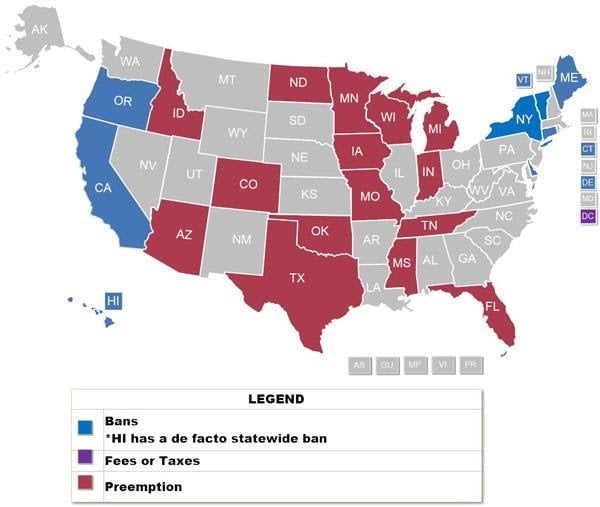
Eight states—California, Connecticut, Delaware, Hawaii, Maine, New York, Oregon, and Vermont—ban the use of plastic bags in supermarkets and other businesses. Soon, New Jersey will be added to the list as its legislature recently passed a ban. Some cities (e.g. Boston, Chicago, and Seattle) have also enacted bans on plastic bags. Fifteen states, however, enacted laws to restrict local officials from enacting a ban on plastic bags to ensure that laws would be uniform throughout their states.
The states and cities that have enacted bans on plastic bags have done so despite studies showing that most plastic bags (78 percent) have a secondary life where people use them for packing lunches or disposing of pet waste or other garbage. Many of the cities and states that have banned plastic bags have overturned them temporarily during the height of the coronavirus pandemic, realizing that they were more sanitary and safer than reusable bags, which are often not washed regularly and more easily carry bacteria and viruses, according to studies on the subject.
Environmental groups found that it was easier to convince local towns and cities to enact plastic bag bans than state bureaucracies. By 2014, 151 California cities and counties had banned plastics. The state followed their lead and became the first state to enact legislation imposing a statewide ban on single-use plastic bags at large retail stores. The state bill also required a 10-cent minimum charge for recycled paper bags, reusable plastic bags, and compostable bags at certain locations. The ban was set to take effect on July 1, 2015, but a referendum forced the issue onto the ballot in the November 2016 election. Proposition 67 passed with 52 percent of the vote approving the plastic bag ban. In 2018, California banned plastic drinking straws and in 2019, legislators outlawed plastic hotel toiletry bottles, passing a bill modeled on an ordinance adopted by Santa Cruz.
A de facto statewide ban exists in Hawaii as all of its most populous counties prohibit non-biodegradable plastic bags at checkout, as well as paper bags containing less than 40 percent recycled material. Bans in Kauai, Maui, and Hawaii counties took effect between 2011 and 2013; Honolulu become the last major county to approve the ban in 2015.
In 2019, New York became the third state to ban plastic bags with passage of Senate Bill 1508. The law, which was supposed to go into effect on March 1, 2020, applies to most single-use plastic bags provided by grocery stores and other retailers. Bags distributed at the meat/deli counter and bulk food area are exempt, as well as newspaper bags, trash bags, garment bags, bags provided by a pharmacy for prescription drugs, and restaurant takeout bags. The law allows individual counties the option of placing a 5-cent fee on paper bags, with 2 cents going to local governments and 3 cents to the state’s Environmental Protection Fund. The law was contested in court, but the ban was upheld and goes into effect on October 19, 2020.
In 2019, five other states enacted legislation to ban plastic bags—Connecticut, Delaware, Maine, Oregon, and Vermont. In addition to plastic bags, Vermont’s SB 113 also placed restrictions on single-use straws and polystyrene containers. In 2009, the District of Columbia enacted legislation requiring all businesses that sell food or alcohol to charge 5 cents for each carryout paper or plastic bag.
Bans film plastic bags, such as those found at grocery stores, regardless of thickness. It also bans paper bags at supermarkets over 2,500 square feet in favor of reusable bags—the first state to do so.
Bans polystyrene clamshell food containers and other products like plates, cups, food trays and utensils
Allows plastic straws to be available only upon request at restaurants.
The alternative, reusable shopping bags, are thought to harbor bacteria and viruses and could facilitate their spread in grocery stores and pharmacies. According to a study of coronaviruses, bacteria and viruses can survive in the tote bags up to nine days.
A number of studies have shown health issues traced to reusable shopping bags. In 2010, several Oregon teens and adults fell ill after attending a soccer tournament, which was traced to a reusable grocery bag that had been stored in a bathroom used before the outbreak by a person with a norovirus-like illness. Soccer players and their chaperones contracted the virus after touching the contaminated bag or eating food carried in it.
A 2011 study of grocery shoppers’ reusable bags showed large numbers of bacteria in almost all of the randomly-searched bags and coliform bacteria in half of them because the majority of shoppers said they rarely or never washed them. An analysis of an outbreak of a novel swine enteric coronavirus disease in 2013 where millions of American piglets died showed that the reusable feed totes were the most likely cause. The feed bags are often made of the same kind of material as reusable shopping bags.
States without Bans on Plastic Bags
States that have enacted laws to restrict local officials from enacting a ban on them include Florida, Idaho, Mississippi, Missouri, North Dakota, Oklahoma, and Tennessee. See the map above for a complete list.
Conclusion
New Jersey is joining the eight states that have bans on plastic bags, and is even banning paper bags. Having grocery store patrons use reusable totes instead of plastic bags means that businesses are not allowed to determine what product is best for themselves and their customers, and forces consumers to supply their own bags, whether they want to or not. The novel coronavirus is just one of many pathogens that shoppers can spread unless they wash their reusable bags regularly, which few people bother to do. Rather than banning plastic bags, it would be more beneficial for states to re-examine their policies and figure out a better way to dispose of them or recycle them. This is especially true since people have become more conscious of potential contamination as a result of COVID-19.
Get a 10% registration discount with exclusive code SEI2020!
SunCast Puerto Rico, a collaboration between the Solar + Energy Storage Association of Puerto Rico (SESA) and SunCast Media, kicks off on October 12-14. This exciting, fully-immersive 3D virtual conference features industry thought-leaders, the latest technology and solutions, and programming supporting Puerto Rico’s 100% renewable energy future.
As with an in-person experience, attendees can explore the conference space, venture into sessions, network freely with other attendees, book a private meeting, and even roam an exhibit floor filled with leading companies. This 3D immersive environment will feature Keynote Talks, Panel Discussions, Exhibitor Booths, Private Meeting Rooms, Networking Lounges and more!
Win a full SEI scholarship at SunCast!
Register to the event and test your solar smarts at SEI’s booth! Respond to our solar trivias and participate for a chance to win a full scholarship for an SEI online course. REGISTER HERE >>
Train with SEI at the Event
Sign up for NABCEP approved English & Spanish Workshops
PV and Energy Storage: Configurations and Applications (3hr)
3 NABCEP CE hours: 3 PVIP JTA
In this course, we will discuss common applications and varying topologies of battery-based PV systems. Topics include DC and AC coupled PV, residential storage systems, zero-sell systems, and solar plus storage systems designed for demand management. Join SEI instructors with decades of experience to learn more about battery-based applications, equipment, and system design.
Verificación de Rendimiento en Sistemas FV (1.5hr)
1.5 NABCEP CE hours: 1.5 PVIP JTA
Verifica si tu sistema FV está produciendo lo que debería. Resaltamos la teoría detrás de lo que debe ocurrir una vez finalizada la instalación de sistemas FV para comprobar si está dando el rendimiento óptimo. Esta es de las herramientas más importantes para la puesta en marcha de sistemas FV, y la base del mantenimiento preventivo. Aprende sobre el cálculo y la estimación de los factores que afectan el rendimiento del sistema en tiempo real, para dar el primer paso hacia la resolución de problemas en sistemas FV.
Though the reports of the carbon tax’s death may be greatly exaggerated, the policy certainly finds itself in a rut. In our age of populism and polarization, the proposals of centrist technocrats have little appeal. We will turn the calendar to 2021 in a few short months and a carbon tax will still prove elusive in the U.S.
As this month’s edition of the Ticker will discuss, the policy consistently fails to survive first contact with politics, be it in the U.S. or elsewhere. But what that may precipitate is a more hidden version of the same fundamental idea.
“30 Years of Carbon Taxes in Sweden” Tax Foundation, September 23, 2020
Implemented in 1991, Sweden’s carbon tax was one of the first in the world, second only to Finland’s carbon tax, which was implemented a year earlier. Sweden levies the highest carbon tax rate in the world, at SEK 1,190 (US $126) per metric ton of CO2. The tax is primarily levied on fossil fuels used for heating purposes and motor fuels. Since the carbon tax was implemented 30 years ago, Sweden’s carbon emissions have been declining, while there has been steady economic growth. Sweden’s carbon tax revenues are significant but have been decreasing slightly over the last decade.
IER’s Take
The banner figure carbon tax advocates will cite from this report is that between 1990 and 2018 Sweden decreased its greenhouse gas emissions by 27 percent. That isn’t insignificant, but it should be put into context.
The United States, without a carbon tax and primarily due to the proliferation of natural gas, reduced its carbon emissions by around 15 percent between 2007 and 2019, which returned emissions totals to a point roughly on par with 1990—despite the U.S. population increasing by 80 million. That means on a per capita basis Americans reduced their emissions by a quarter. Swedes, in the same period, reduced their emissions by a third.
When compared with a non-tax scenario, Sweden’s marginal emissions reduction looks less impressive—especially when it comes with the price tag of 126 USD per metric ton of CO2.
As this report points out, the numbers are a bit disappointing and it’s reasonable to point the finger at politics. Politics, mind you, that would play out in much the same way here in the States. Due to exemptions and carveouts in the Swedish code, only 40 percent of all emissions, Tax Foundation reports, are covered by the carbon tax. Many emissions-intensive and trade-exposed businesses are granted leeway. To the chagrin of the economists who find Pigovian taxes so very seductive, political considerations alway seem to get in the way.
It was a cold February day in Salem, Oregon, and Republican state senators were fleeing the capitol…The Republicans had bolted from Salem to avoid voting on a policy aimed at slashing planet-warming pollution.The bill on the table, H.B. 2020, would have put a price tag on carbon emissions — long considered one of the simplest and most efficient ways to cut greenhouse gases. It seemed like a no-brainer for a state that, like many of its West Coast neighbors, has faced record-breaking heat waves, disappearing glaciers, and choking wildfires in recent years.
With Oregon’s Republican senators in hiding, the effort failed. H.B. 2020 joined a series of bills and ballot measures across the United States — from Massachusetts to Washington state — that proposed putting a price on carbon and have remained stuck in the waiting room of American politics, never turning into law.
It’s an unexpected turn for an idea that, for more than a decade, was often at the forefront of plans to address climate change — and even held the promise of garnering bipartisan support…Today, however, both parties are largely silent on the idea, if not outright hostile.
IER’s Take
This piece is worth reading, if only to step into the minds of the frustrated pro-tax crowd. Their moment seems to have passed and they are now coming to grips with the challenge endemic to their proposal: how do you convince people that getting less value at a higher price is in their best interest? I consider myself fortunate that I’m not faced with that quandary.
As Noah Kaufman asked somewhat humorously, “From a political standpoint, why would you lead with the idea that you’re going to tax someone?” Alas, the carbon taxers did lead with that and gave tax skeptics a plank we have yet to relinquish.
The purpose of this conference is to discuss considerations related to state-adoption of mechanisms to price carbon dioxide emissions, commonly referred to as carbon pricing, in regions with Commission-jurisdictional organized wholesale electricity markets (i.e., regions with regional transmission organizations/independent system operators, or RTOs/ISOs). This conference will focus on carbon pricing approaches where a state (or group of states) sets an explicit carbon price, whether through a price-based or quantity-based approach, and how that carbon price intersects with RTO/ISO-administered markets, addressing both legal and technical issues.
IER’s Take
Though the carbon tax looks unlikely to take center stage any time soon, more insidious means of forcing an energy transition via a carbon price remain under discussion. The Wednesday, September 30, technical conference hosted by the Federal Energy Regulatory Commission highlighted one such possibility.
The layman’s upshot of the full-day event is that a path to a hidden carbon tax may lie with FERC’s ostensible authority to harmonize wholesale electricity markets. The fundamental question discussed on Wednesday was how FERC should handle a proposal for a state carbon tax, should one arise in a multi-state RTO/ISO market with differing state policies.
The appetite for such harmonization among the panelists appeared to be concerningly robust, particularly among certain industry executives. One light of opposition, however, shone from Chris Parker, executive director at the Utah Department of Commerce. Parker pushed back on the technocratic consensus, stating that Utahans would object to extraterritorial taxation by way of wholesale electricity markets. FERC, Parker argued, must respect all state policy preferences, including those opposed to carbon pricing.
People around the world are having important discussions about systemic racism, overt and covert bias, and how we can all do better.
Understanding the problem is the first step. To get a sense of conditions within the SEO community, we asked people to take our Diversity and Inclusion in SEO survey as part of our ongoing project to study the state of SEO.
Due to the subject matter and the way we reached out, our respondents were not a snapshot of the industry as a whole. We were very pleased to have 326 SEOs complete the survey, including a significant number of female, BIPOC, and LGBTQ+ participants. These are important voices that need to be heard, but as we analyzed the data, we were careful not to generalize the industry as a whole without accounting for potential sampling bias. We addressed this by looking at groups separately — straight white cisgender men, BIPOC women, LGBTQ+ men, and so forth.
We recognize that intersectionality is common. Many of the SEOs who shared their stories with us don’t fit neatly into a single group. We addressed that by counting people in each category that applied to them, so a gay Black man’s answers would be factored into both the LGBTQ+ and BIPOC analyses.
Who participated?
Of the 326 SEOs who participated, 231 respondents (70.9%) described themselves as white. Among the rest, 32 SEOs described themselves as Hispanic, Latino, or Spanish; 28 Black or African American; 18 Asian or Asian American; 11 Middle Eastern or North African; eight Indian or South Asian; four Native Hawaiian or other Pacific Islander; and three American Indian or Alaska Native. (Some people were counted in more than one category.)
Our respondents included 203 SEOs who identify as women (including one transgender woman), 109 who identify as men (including two transgender men), and 11 who consider themselves nonbinary, genderqueer, two-spirit, or gender nonconformist. Three people preferred not to share their gender.
With regard to sexual orientation, 72.8% described themselves as heterosexual, 25.2% as LGBTQ+, and 2% preferred not to say.
About two-thirds (218 SEOs) of the participants were from the U.S., and about one in 10 (35 SEOs) were from the United Kingdom. The rest came from 26 other countries across the globe. The average age was 34.5 with 6.9 years of experience in SEO. (Please see the methodology section at the end for more details.)
How is the SEO community doing with diversity and inclusion?
We started our study by asking SEOs how our industry compares with the rest of the business world when it comes to discrimination and bias. More than half of our participants (57.7%) had a different career or significant job experience in another field before working in SEO, so we figured they’d be in a position to know.
Overall, most people (58.7%) think SEO is about the same as other professions. But among those who disagree, more think it’s worse (26%) than better (15.2%).
Surprisingly, there was also no statistically significant difference between BIPOC and white respondents when we asked about prevalence of bias in the industry. However, when we asked how big a problem it is, things got interesting.
Both BIPOC and white SEOs felt much more positively about their own companies than the industry as a whole.
Slightly more than 40% of both BIPOC and white SEOs said discrimination is “not a serious problem at all” within their own companies. However, almost three-quarters of BIPOC SEOs (74.0%) and more than two-thirds of white SEOs (67.5%) said bias is a “moderately serious” or “extremely serious” problem in the SEO industry.
Emotions ran high in the comments for this section. Jamar Ramos, 38, the black male chief operations officer of Crunchy Links in Belmont, California wrote, “White men on SEO Twitter are the f***ing worst. They are defensive, uncouth, and destructive for the industry. So scared of losing power they will drive EVERY BIPOC from SEO if they could.”
Another Black SEO, a 29-year-old woman at a Chicago agency, commented, “As a Black woman (and queer at that), I have definitely not seen a woman like me. I always (somewhat) joked around that I'll be the Queen of SEO, but underneath those words was because I saw not only women underrepresented in the industry, but other minority subsects of being a woman underrepresented as well, such as being a Black woman and/or a queer Black woman. Where are we?!!"
Other perspectives were represented, as well. Said another 28-year-old Black female SEO, “I'm thrilled to work in an industry where there is the freedom to find multiple agencies that are welcoming to all, and the additional freedom to strike out on my own if I ever felt I should.” Many comments in later sections backed up these sentiments, with endorsements of the SEOs’ own companies and their diversity and inclusion policies.
How bad is it? Frequency of racial or ethnic bias in SEO
Our respondents were more diverse than the SEO industry as a whole, so we expect that their experiences would be a bit different, as well. Also, our survey was based on self-reporting, which can be inconsistent. That said, overall, 48.7% of our respondents told us they never experience racial or ethnic bias. Among the others, 6.7% experience racial or ethnic bias at least once a week, 10.9% at least once a month, 9.2% every couple of months, and 24.4% said it was rare but did happen on occasion.
Knowing that 7 out of 10 of our respondents were white, we broke the data down by the SEOs’ self-reported ethnic backgrounds to get a clearer idea about the extent of racial or ethnic bias. Here’s what we found.
Asian and Asian American SEOs were the most likely to say they experience ethnic bias at least once a week, followed by Hispanic or Latino SEOs.
Most Black or African American SEOs said discrimination was a monthly or bi-monthly experience for them. Not surprisingly, white SEOs were the least likely to experience racial or ethnic bias, although about a third said they do get discriminated against based on their heritage or cultural identity.
We’d like to know more about the racial and ethnic discrimination white SEOs are facing. Unfortunately, we focused on BIPOC and LGBTQ+ issues in this survey and did not include questions about religion, so we don’t know what role that might play. We also did not address ageism or disability issues. With each study we publish, we realize how much more we have to learn. We will be sure to explore those issues in future studies.
Gender and LGBTQ+ bias in SEO
There are a lot of forms of LGBTQ+ and gender bias. We let our survey participants interpret the phrase for themselves when asking how often they experience it. Overall, 94.1% of LGBTQ+ SEOs experience bias at least some of the time, and more than a third do so at least once a month. However, 72.5% of the heterosexual SEOs also said they feel gender discrimination at least some of the time.
The impact of bias
About 4 in 10 SEOs said they experienced bias in the past year. We asked them what impact it has had on their productivity, career trajectory, and happiness. Here’s what they said:
69.1% feel“Bias in the workplace has had a negative impact on my productivity and sense of engagement.” (38.3% strongly agreed; 30.8% slightly agreed)
72.1% feel “Bias in the workplace has had a negative impact on my career advancement and earnings.” (39.3% strongly agreed; 32.8% slightly agreed)
74.6% feel “Bias in the workplace has had a negative impact on my happiness, confidence, or well-being.” (42.6% strongly agreed; 32.0% slightly agreed)
The cost of bias
How do discrepancies in pay, being passed over for promotion, and other forms of discrimination add up over the course of a career? There are many variables when comparing incomes. For example, pay can vary based on years of experience, size of company, and specific expertise.
We did the best we could to compare the incomes of SEOs with similar career profiles. Ultimately, we chose to focus on SEO generalists working in the United States, which gave us the largest pool of responses. We broke them down by gender, ethnicity, and age. Our sample sizes for men ranged from 8 to 22 people in each subcategory. Our sample sizes for women ranged from 13 to 35 for each subcategory.
These were small groups, so the results are far from definitive. But the consistency of a disparity merits conversation. Here’s what we found.
For male SEO generalists working in the United States:
In their 20s, white male SEOs reported earning an average of $75,312 per year. BIPOC male SEOs in their 20s reported earning an average of $63,500 per year (18.6% less).
In their 30s, white male SEOs reported earning an average of $95,833 per year. BIPOC male SEOs in their 30s reported earning an average of $89,091 per year (7.6% less).
In their 40s, white male SEOs reported earning an average of $115,937 per year. BIPOC male SEOs in their 40s reported earning an average of $90,417 per year (28.2% less).
For female SEO generalists working in the United States:
In their 20s, white women SEOs reported earning an average of $75,384 per year. BIPOC women SEOs in their 20s reported earning an average of $61,250 per year (23% less).
In their 30s, white women SEOs reported earning an average of $86,571 per year. BIPOC women SEOs in their 30s reported earning an average of $86,094 per year (0.6% less).
In their 40s, white women SEOs reported earning an average of $109,375 per year. BIPOC women SEOs in their 40s reported earning an average of $101,094 per year (7.6% less).
What does on-the-job bias look like?
“Where are you really from?”
“Are you the new diversity hire?”
“But you all look alike.”
“You’re Asian, so you’re good at math, right?”
“You don’t speak Spanish?”
“Do you play basketball?”
“I think what she was trying to say was…”
It can happen to anyone, but people of color, members of the LGBTQ+ community, and women hear things like this often. A microaggression is a subtle behavior directed at a member of a marginalized group. It can be verbal or nonverbal, delivered consciously or not, and can pose a cumulative, damaging effect to the receiver.
Columbia University defines racial microaggressions as “brief and commonplace daily verbal, behavioral, or environmental indignities” that contain “hostile, derogatory, or negative” content or subtext. The result, according to a City University of New York study, can be “anxiety and depressive symptoms over and above the effects of non-race-specific stress.”
Minority racial and ethnic groups are often targets of microaggressions, but these offenses can be directed at any marginalized group in addition to people of color, including women, people with disabilities, individuals in the LGBTQ+ community, those with mental illness, single parents, and people in lower economic classes.
Many SEOs reported experiencing a cascade of microaggressions and similar offenses. A 46-year-old white woman in the U.K. with more than 15 years of experience in the field wrote, “I don’t feel I get taken at all seriously as a female SEO — to the extent that I stopped attending events years ago. It’s a total boys club, to the point of afterparties at strip clubs. As a woman, I’ve had male SEOs expect me to do all the legwork because my time is less important, and then they try and take credit for my work. When I called them out, I was met with bullying. It’s a disgusting situation to still be in after this long in the industry.”
The most common microaggression reported during the past year, by more than 4 in 5 SEOs (81.4%) in our poll, was being interrupted or spoken over. Second on the list, however, was an actively offensive action: Nearly 6 in 10 reported having an idea taken by someone else (57.5%).
Perhaps unsurprisingly, 44.1% of respondents reported being paid less than similarly qualified employees. A 2016 Pew Research center report supported the data on this enduring travesty with regard to race and gender. Additionally, Census Bureau data from as recently as 2018 showed that women of all races still earn 82 cents for every dollar earned by men.
Among the 48.4% of respondents who report being talked down to or treated as less capable than similarly qualified employees, several made poignant comments to back up their responses.
A 26-year-old biracial woman at a small Midwestern agency said, “I am constantly having to prove my case or strategies, even when the target audience I am marketing/optimizing for looks more like me than my colleagues. I am questioned constantly and asked to prove my work, despite being the only person at the company with the knowledge and skills to produce the work.”
And one technical SEO said, “I am a white, cisgendered woman, so I have a lot of privilege, but I still have clients who feel the need to verify my recommendations with their own ‘research’ (rudimentary Google search) or by checking my advice against the opinion of white men, many of whom have less experience than I do (‘My nephew learned about SEO in college, and he says …’).”
Other common verbal microaggressions reported by survey respondents include being addressed unprofessionally (41.3%), hearing crude or offensive jokes about race and ethnicity (36.1%), or about sexual orientation or gender identity (38.5%).
Drilling down: specific microaggression experiences by group
We asked SEOs in our survey about the types of microaggressions they’ve been exposed to in the field, and found that some types of microaggressions are more commonly experienced by certain groups. We sorted respondents into six groups based on gender, ethnicity, and LGBTQ+ orientation to see how different issues affected each demographic. In some cases, we found surprising results.
At least half of SEOs in each group registered the most common microaggression: being interrupted or spoken over. In all, 91.1% of straight, white, cisgender women and 90.7% of LGBTQ+ women report this happening to them, while a surprising 82.5% of straight, white, cisgender men share the experience. Men in the BIPOC group reported barely half as many incidences of this microaggression in their experience.
All three categories of women were most likely to report a pay gap and having their ideas stolen. Reports from straight, white, cisgender women (65.8%), LGBTQ+ women (60.5%), and BIPOC women (59.3%) were remarkably consistent, falling within just slightly more than six percentage points of one another.
Meanwhile, men in the BIPOC group were most likely to say they’d been passed over for a promotion (41.7%), followed closely by LGBTQ+ men (40%), and women (37.2%).
Bad-faith banter
Conversations on the job were fertile ground for verbal microaggressions of different types. What some might consider harmless banter may not be harmless at all. We explored jokes and other verbal interactions that SEOs reported as disrespectful and hurtful.
We defined four different categories and found that the most common complaint occurred among straight, white, and cisgender women, 68.4% of whom reported “being talked down to or treated as less capable than similarly qualified employees.”
The other two most common complaints involved hearing “offensive jokes about race or ethnicity.” A total of 58.3% of BIPOC men reported hearing such jokes, but interestingly, even more LGBTQ+ men (60%) said they’d been exposed to this kind of inappropriate humor. And 37% of BIPOC women endured the same treatment.
A disappointing wealth of examples of this egregious behavior was described in the comments.
A 32-year-old white SEO who identifies as gender nonconformist described the time a “past employer, during the interview process, told me he wanted to make it clear to his (service industry) customers he wasn’t going to send any Black people to their homes. This job was rampant with racism and misogyny. I took the job out of desperation and got out as soon as I could.”
Another SEO, a 37-year-old Black woman, wrote, “When starting out, I worked at a boutique agency where many people felt comfortable telling Black and Asian jokes to me. I was on time for a business trip meetup at 5 a.m. and one employee joked that he didn’t realize Black people could get up that early. I left as soon as I could get another job that wouldn’t ding my résumé.”
Slightly more than 53% of LGBTQ+ women and men responded that they’d heard offensive jokes about gender identity or sexual orientation, the highest in that category. Likewise, LGBTQ+ men (20%) and women (14%) were most likely to have been asked how they got hired.
Mixed messages at work
Next, we considered four categories in which employees are implicitly singled out because of their membership in a marginalized group.
On the one hand, we asked whether group members had been singled out to promote an appearance of diversity — through tokenism or by assigning them to resolve problems of bias. The dubious value that such a request (under the best of circumstances) might signify, though, is negated by their opposite and often accompanying tendencies: targeting certain people or groups with suspicion (by being monitored more closely) or with criticism for their being “too sensitive” to discriminatory language/behavior.
LGBTQ+ men were most likely to report instances of tokenism (26.7%) and being labeled “too sensitive” (33.3%) to discrimination. BIPOC women ranked next in those categories, with 22.2% and 29.6%, respectively. Similarly, one-third of BIPOC women (33.3%) reported being supervised more closely than similarly qualified employees.
The comments for this section were rife with examples, like the one from a 36-year-old Hispanic/Latino male who described “being asked to ‘woke-check’ social content to see if anything in it might trigger a backlash from the immigrant community.”
Unsurprisingly, straight, white, cisgender men and women ranked in the bottom half of those reporting in each of the four categories. But men and women in other categories reported varying results. Nearly three times as many LGBTQ+ men (26.7%) as women (9.3%) said they’d experienced tokenism. Meanwhile, BIPOC women were far more likely than men — 29.6% to 8.3% — to report being labeled “too sensitive” for calling out discriminatory behavior or language.
We specifically asked BIPOC respondents to our survey how often they’d experienced three common forms of microaggression, dividing participants into four groups:
Middle Eastern/North African
Black/African American
Hispanic/Latino
Asian/Asian-American
All four groups reported that the most common of the three microaggressions we asked about was being complimented for being articulate or “well-spoken” — indicating an implied and unfounded expectation that they wouldn’t be. Three-quarters (75%) of Middle Eastern/North African respondents and two-thirds (66.7%) of Black/African American survey participants said this had happened to them.
In addition, nearly half (47.6%) of Hispanic/Latino group members surveyed said they’d been asked where they’re “actually” from. This was at least 20 percentage points higher than for any of the other three groups. The results appear to reflect a bias against immigrants from Mexico and Central America, and a baseless distrust of their status as citizens or legal residents.
The third question explored what researchers have identified as a tendency to view members of other racial or ethnic groups as interchangeable: a bias that can lead to stereotyping and discrimination. In this instance, Black/African American participants were significantly more likely (44.4%) to indicate they’d been mistaken for someone else of their race or ethnicity.
How diverse are SEOs’ workplaces?
Representation of diverse populations is a huge issue in the microcosm of the SEO industry, as well as the macrocosm of business and society in general. We were interested in how SEOs viewed diversity in the rosters at their workplaces, both in the rank-and-file employee roster and in executive or leadership positions.
Survey respondents were nearly evenly split between working for an agency and working in-house at a company (45.9% and 42.2%, respectively), while the remainder split the difference between freelancing (5.3%) and consulting (6.6%) in the SEO field.
Overall diversity levels never exceeded 15.3% for organizations of any size, hitting that level for companies with 2-10 employees and again for businesses with 251-1,000 workers. Companies with 11-25 workers turned in a percentage of 12.1%.
Percentages were lowest at the largest corporations, with the worst showing (5%) at companies with 5,001-10,000 workers. Companies with more than 10,000 employees (6.5%) and with 1,001-5,000 workers (6.9%) did only slightly better. One-person companies were also relatively less likely to be diverse than other small or midsize businesses, at 7.5%.
To further plumb the depths of representation in various SEO employment situations, we asked survey respondents to estimate the level of diversity in their organizations, including at leadership levels. We asked the same question for racial and ethnic diversity and for gender and LGBTQ+ diversity.
BIPOC diversity
In exploring diversity levels for SEOs with regard to race and ethnicity, we found a fairly even split between those that were rated “somewhat” or “very diverse” (slightly more than 54%) and those that were “not very” or not at all diverse (roughly 46%). At the extremes, roughly 16% were very diverse, and just slightly less were not diverse at all.
But, as mentioned, leadership is less diverse: Fully half (50.4%) of companies said they had no diverse individuals in leadership roles, and just over 7% reported more than half of their leadership was diverse. In total, 82.5% of respondents said diverse individuals comprised less than 25% of their company’s leadership or less.
At major tech companies such as Facebook, Apple, and Microsoft, the bulk of racial and ethnic diversity in 2017 was represented by Asian employees, with Black and Hispanic employees making up just small slivers of the workforce.
Gender and LGBTQ+ diversity
When it comes to gender or sexual orientation, diversity results are slightly higher than those for race and ethnicity. More than 6 in 10 respondents (61.8%) answered that their companies were either very (20.9%) or somewhat (40.9%) diverse, compared with just 12% who said they were not diverse at all.
More specifically, however, the data seems to indicate less diversity.
For women, a 2018 report by the National Center for Women & Technology found that their share of the workforce at tech-related companies was 26%, far shy of the 57% for the U.S. workforce in general. Meanwhile, Black, Latina, and Native American women made up just 4% of computing jobs, even though they accounted for 16% of the overall population.
The numbers for LGBTQ+ leadership in our survey were even less encouraging: More than 4 in 10 survey participants (41.7%) said their leadership teams did not include any LGBTQ+ members, while a mere 4.4% said that more than a quarter of those team members were LGBTQ+ individuals.
An interesting finding: 37.4% of those who responded said they were not sure about the LGBTQ+ membership composition of their leadership teams. This would seem to indicate that many team members choose not to share their sexual orientation, suggesting a bigger-than-expected separation between private and professional life.
How important is diversity in SEOs’ workplaces?
In answer to the question, “Is diversity and inclusion a priority in your company,” the comments varied widely. Some respondents simply answered “No” — or if it was, they weren’t aware of it.
At the other end of the spectrum were comments along the lines of “We don’t need to try; our team is just naturally diverse and inclusive.” (As with other responses, the survey cannot address the accuracy of self-assessment.) Several other comments indicated that the company strived to hire the best person for the job, “regardless of any stereotype.”
Other responses were slightly more specific. Several said their companies had only started focusing on diversity in response to the Black Lives Matter movement after George Floyd’s death in police custody.
Others indicated that their companies have an established focus on gender equality, but had only recently begun to address BIPOC or LGBTQ+ issues. A 34-year-old gay white man at a large company wrote, “Diversity and inclusion is a priority for the gender pay gap, but doesn’t include or reference race or LGBT. There’s a women’s mentor program to help promote women to higher roles, and there’s a women’s network to raise visibility.”
When asked whether diversity was a priority at their company, nearly half (49.7%) of the SEOs indicated that it was — nearly three times as many as those who said it wasn’t (17.2%). One in five (20.34%) weren’t sure, and 12.8% checked “Other” and were asked to elaborate with specific responses. Roughly 19% of those questioned elected not to answer.
What steps do companies take to encourage diversity and inclusion?
The prevalence of “Yes” answers was encouraging. Many of these were followed up with detailed descriptions of initiatives and programs in place to promote diversity and inclusion at the respondents’ workplaces.
For example, a 29-year-old Black woman who described her company as “very diverse” detailed the organization’s initiatives like this: “We have a diversity and inclusion council with men and women of all different backgrounds from across the world. We have a North American task force; we publish our diversity data; we do outreach to educational institutions including HBCUs [historically black colleges and universities] to source talent; and we have anti-racism and inclusion training.”
Also, a 28-year-old woman who identifies as American Indian or Alaska Native in Austin, Texas, commented, “Our leadership has recently made great strides to take action to ensure diversity and inclusion is a topic our entire company is knowledgeable about. We are also taking actions to raise awareness about inequality in the tech industry in a landmark report about BIPOC in tech as well as finding ways to volunteer with a BIPOC kids coding organization.”
The number and breadth of diversity and inclusion initiatives our SEOs described were also encouraging. These ranged from interactive activities such as diversity training sessions and workshops to company communication efforts like informative newsletters and the publication of diversity data.
When it comes to personnel management, some businesses are further seeking to instill diversity and excise bias in their criteria for recruiting, hiring, and promoting. And, especially important in response to the on-the-job-learning aspects specific to the SEO field, participation in internships and mentoring programs is also a growing and well-supported option.
A 28-year-old Black nonbinary SEO described several initiatives at her large agency, saying, “They have a group focused on diversity, equity, and inclusion. They are updating their practices around recruiting and interviewing to remove any unconscious racial biases. And, providing mandatory anti-racist training for all employees.”
For more detailed information on the measures companies are enacting to improve diversity and inclusion within their organizations, continue to the section below.
What are some solutions?
Diversity and inclusion data can look discouraging overall, but anecdotal responses told us that a breadth of measures are being taken to address disparities in representation, discriminatory practices, and inherent bias in everyday operations. Here are several of the initiatives cited by survey takers to enhance diversity and inclusion in the SEO workplace.
1. Initiatives at the corporate level
Employee participation in and consultation with advisory panels and task forces was a commonly cited effort, in addition to compiling and distributing informative resources like newsletters and reading lists. Several respondents described opt-in cultural activities designed to facilitate diversity, such as setting up Slack channels around particular affinities or topics, establishing employee book clubs, and spotlighting diversity in holiday celebrations.
One SEO generalist in the U.K., a 37-year-old white woman, described several activities of her company’s diversity organization, among them “[organizing] events around different holidays so everyone feels included. We celebrate Eid and Diwali, for example, and everyone in the company is encouraged to share and request days organized around things that are important to them. It’s a great initiative and I’ve learned so much from people openly sharing and discussing.”
2. Employee resource groups
Affinity-based employee resource groups, or ERGs, were cited as extremely valued resources for SEOs. These groups foster safe and informed forums in which different groups can gather to discuss issues, devise requests, suggest solutions, and share information.
One SEO manager, a 58-year-old white trans woman with nearly 15 years in the business, commented, “I am a five-time elected board member of the LGBTQIA ERG diversity group, Pride. We have seven ERGs here at [my company].”
Depending on the workplace and its demographics and company culture, ERGs may center on shared issues of gender, age, race and ethnicity, LGBTQ+ orientation, disability, mental health, neurodiversity, religion, parenting, military or veteran status, international communities, women in leadership, and more.
Naturally, any group is most effective and receives greater respect and resources when it’s sponsored and promoted by leaders at the executive level — whether or not the leaders share the demographics of the group.
3. Personal education and growth
Each individual has a responsibility to self-educate on topics related to bias and discrimination, diversity, equity, and inclusion surrounding the struggle of groups historically targeted for exclusion and injustice.
4. Allies in leadership
The support and advocacy of leaders at the executive level is not only the only ingredient necessary for changing company cultures overall. The vocal and steadfast support of allies from other groups is essential — and, unfortunately, often still lacking.
One SEO consultant, a 49-year-old woman who is biracial Latina and white, put it quite succinctly: “I see a lot of women in the SEO industry speaking out about the lack of diversity and inclusion, but very few men in the industry. Whenever one of these conversations gets going on Twitter, most of the men in SEO whom I follow suddenly get very quiet. The industry is only going to change when men also start taking action and speaking out about how the industry treats everyone other than men. Silence is complicity.”
5. Speaking up: see something, say something
Many people witness incidents of bias but struggle with how to respond. Especially if a company has not formalized a set of procedures for addressing such conflicts, employees are left to figure it out on their own.
As we know, there is no standardized societal guidebook for how to deal with discriminatory situations, especially in the U.S., where attitudes can be polarized and discussions difficult to initiate or sustain. Consequently, people chose a variety of responses to these situations, as evidenced by these findings:
As part of our survey, we asked participants whether they’d witnessed discrimination or bias against someone in their workplace during the past year based on race, ethnicity, gender, or sexual orientation. In all, 43.2% replied that they had, so we asked these participants to go further by telling us what they did in response.
Of that group, more than 4 in 10 (42.9%) took no action because they didn’t feel comfortable getting involved. This was true even though the U.S. Equal Opportunity Commission has declared that workers “have a right to work free of discrimination” based on “race, color, religion, sex (including pregnancy), national origin, disability, age (age 40 or older) or genetic information.”
One reason may be fear of retaliation, which the EEOC found was the most common issue cited by federal employees in discrimination cases. The same is likely true in the private sector. Respondents may fear the outcome if their employer fails to act on their report, and/or the accused discovers the source of the complaint.
In light of this, it was encouraging to find in our survey that 41.2% of witnesses to workplace discrimination told their supervisor. (Another option, reporting the conduct to Human Resources, was not included as a choice among our survey answers).
The most common answer: 56.3% confided in a colleague. This might indicate that these respondents weren’t comfortable going to an in-house supervisor, but also that they felt distressed enough about the situation that they wanted to tell someone.
Among other responses, slightly more than one-third (33.6%) spoke out in the moment, while others addressed the situation later, either with the target of the discrimination (37.8%) or the perpetrator (21%). In the accompanying comments, several reported following up later with both the target and the perpetrator.
6. Mentoring someone from a different background
SEO is a peculiar field in that there isn’t a well-defined path into the industry. The majority of SEOs are self-taught or learn on the job, figuring things out as they go. Or they have a mentor. One in three SEOs surveyed (33.1%) said mentors were their most significant source of SEO knowledge early in their careers.
Our survey asked four questions that went to the question of diversity among mentors. The first two asked whether respondents had worked with a mentor 1) of their own gender and/or 2) of the same race/ethnicity as theirs.
The results were interesting. While only 41.9% reported working with a mentor of their own gender, more than two-thirds (69.5%) said they’d worked with one of the same race/ethnicity. This would seem to indicate more diverse interaction among genders than exists between people of different races and ethnicities.
The next two questions asked whether respondents had worked with a BIPOC mentor and a member of the LGBTQ+ community. In terms of diversity, the results of the first question were disappointing, while answers to the second were encouraging.
A total of 10.8% said they’d worked with a BIPOC member, but that was far short of the U.S. population for that category, according to the U.S. Census. Black Americans alone accounted for 13.4% of the U.S. population in 2019, according to Census Bureau estimates, with Hispanic/Latino individuals checking in at 18.5%.
By contrast, 10.4% of respondents in our survey said they’d worked with a mentor from the LGBTQ+ community. That’s nearly double the percentage of LGBTQ individuals in tech-heavy California during 2019, according to the UCLA School of Law Williams Institute, which placed the figure at 5.3%.
Methodology
These insights were the result of a month-long survey of 326 SEO professionals conducted by North Star Inbound from August 24 to September 28, 2020. We promoted the survey on Twitter, our own blog, and by email. We’re grateful to Moz and Search Engine Land for also sharing the link.
In terms of gender, the SEOs described themselves as follows:
203 identify as women
109 identify as men
1 is a trans woman
2 are trans men
11 are nonbinary, genderqueer, two-spirit, or gender nonconformist
3 preferred not to say
With regard to sexual orientation:
72.8% said they were heterosexual
11.5% said they were bisexual
4.1% said they were pansexual
3.9% said they were gay
3.3% said they were lesbian
1.1% said they were asexual
1.9% preferred not to say
The SEOs described their race or ethnicity as follows: (Participants were able to check more than one box)
233 White
30 Hispanic, Latino, or Spanish
25 Black or African American
13 Asian or Asian American
7 South Asian/Indian subcontinent
5 Middle Eastern/North African/Arabian peninsula
4 Native Hawaiian or other Pacific Islander
2 American Indian or Alaska Native
The SEOs who completed the survey came from the following countries:
218 from the U.S.
35 from the U.K.
11 from Canada
9 from Germany
8 from Taiwan
6 from Spain
2 each from Australia, Brazil, France, India, Israel, Japan, the Netherlands, Nigeria, Poland, Romania, and Switzerland
1 each from Argentina, Austria, China, Ireland, Italy, Lithuania, Malta, Mauritius, Peru, Portugal, and Turkey
The survey respondents’ average number of years in SEO was 6.9. The median number of years was 5. The average age was 34.5, and the median age was 32.
Sign up for The Moz Top 10, a semimonthly mailer updating you on the top ten hottest pieces of SEO news, tips, and rad links uncovered by the Moz team. Think of it as your exclusive digest of stuff you don't have time to hunt down but want to read!
IER questions inappropriate “donations” to municipalities and media, calls for funds to be returned.
_______________
WASHINGTON DC (October 7, 2020) – Today, the Institute for Energy Research (IER) released another update to its Big Green, Inc. database. IER’s latest unveiling details the money trail between innocuous sounding foundations to green activist groups that advance an irresponsible energy and environmental agenda at all levels of government, and in the media. IER says these foundations need to be called out for their hidden, far left agenda and their overwhelming influence in American politics.
The main players in today’s update center on the Rockefeller Foundation and the William and Flora Hewlett Foundation. Together, these two foundations funneled more than $215 million to 290 environmental groups and projects in 2017 alone. Many of these grants promoted policies that undoubtedly seek to reverse America’s recently obtained energy independence and raise the cost of energy on all American households. Also uncovered in the most recent investigation was a $325,000 contribution to The New York Times. While event sponsorship from foundations, organizations and even corporations is not uncommon, The Times did not disclose the clear quid pro quo related to these “grants” in its climate reporting. IER is calling on the The Times to either disclose all of its sponsored content, like nearly every other news publication in America, or better yet, do the right thing and return the funds along with an apology to its readers.
These sums, along with the grants from thirteen other foundations, amounted to nearly $536 million in just one year. To date, the Big Green, Inc. database has tracked environmental grants stemming from seventeen foundations that has been directed to hundreds of green groups totaling $5.2 billion.
IER President Thomas Pyle made the following statement:
“With this latest update to Big Green, Inc., the research team at IER continues to shine a bright light on the influence of the deep-pocketed far left, modern green movement and the media. Foundations like Rockefeller and Hewlett are funneling hundreds of millions of dollars to promote false narratives about energy derived from our God-given natural resources and our ability to effectively make our infrastructure more resilient.
“A disturbing discovery in this latest round of research is the grant accepted by The New York Times. The fact that The Times would be comfortable taking such a large sum of money to advance the agenda of the Rockefeller Foundation calls into question their objectivity. The Times should return the $325,000, apologize to its readers, and pledge to cover energy and environmental issues more fairly and objectively from now on.”
Key findings from the latest Big Green, Inc. update include:
• The Rockefeller Foundation, started by a man who made his fortune in the oil business, awarded more than $61 million in grants to a variety of projects that aim to eliminate the production and consumption in the United States of coal, oil, and natural gas. The foundation granted $33 million to its own climate change resilience-focused nonprofit, 100 Resilient Cities, which abruptly shut down in 2019. The Rockefeller Foundation also granted $325,000 to The New York Times to “elevate the discussion regarding the crucial need for resilient and inclusive cities” under the auspices of climate change. This coincided with favorable reporting of the Rockefeller Foundation’s 100 Resilient Cities initiative, a project that pushed for increased spending and the appointment of “chief resilient officers” in various cities. In the article cited above, the New York Times does not disclose any financial connection to the Rockefeller Foundation.
• The William and Flora Hewlett Foundation, founded in 1966 by Silicon Valley giant William Hewlett and his wife, in 2017 funneled $153.7 million in grants to 135 environmental entities. These grants went to a variety of national and global public engagement initiatives and other projects opposing oil and coal, which, of course, are required to produce and power their products. Notably, the foundation awarded $1 million dollars to the Sierra Club’s Beyond Coal Campaign, more than $13 million in grants to the Energy Foundation in China and more than $3 million to the United Nations Foundation for “projects of sustainability” during this period.
• The Schmidt Family Foundation, founded in 2006 by the executive chairman of Google awarded a $1.7 million grant to the William J. Clinton Foundation “to allow implementation of carbon finance projects that benefit the poor.” Additionally, they awarded $100,000 in grants to both the City and County of Denver for an electric vehicle marketing campaign and the City of Austin-Austin Energy for a green transportation project. The foundation also gave funds to Yale University for a climate change communications program.
About Big Green, Inc.
Big Green Inc. is a project of IER that catalogs the influence of the deep-pocketed left on energy and environmental policy in the United States. The online resource enables users to navigate the various foundations that spend billions of dollars supporting aggressive climate litigation, the promotion of uneconomic renewable energy sources, and overburdening regulations on natural gas, oil, coal, and nuclear power. Their money has helped foment the anti-market sentiment that dominates energy policy in the United States and has played a major role in limiting economic growth in recent years.
The foundations highlighted by Big Green Inc. are not just being spent in America, but are also tied to foreign actors, complicating geopolitics and potentially posing a threat to our national security.
Most green groups who depict themselves as a modern day David battling Goliath are actually well-funded green pressure groups backed by these foundations.
Far-left foundations are pouring money into organizations and campaigns that peddle fear about the impacts of climate change and influence policymakers with questionable scientific evidence.