Thursday, January 25, 2018

Solar Energy International (SEI) will be attending Greentech Media Mexico Summit 2018

With Latin America’s emergence as the hottest region for solar development in recent years, Mexico has taken the lead with a dynamic energy transition that sets the stage for unprecedented solar growth. Solar Summit Mexico will leverage GTM Research’s expertise in Mexico to ensure your company is uniquely positioned to capture specific opportunities while appropriately managing regulatory, political, and market risks.

Solar Energy International (SEI) is a proud partner of this must-attend event. Join us with GTM February 13-14 in Mexico City, Mexico using our exclusive discount code SEI15 for 15% off your conference registration. Learn more: https://goo.gl/dF3anG

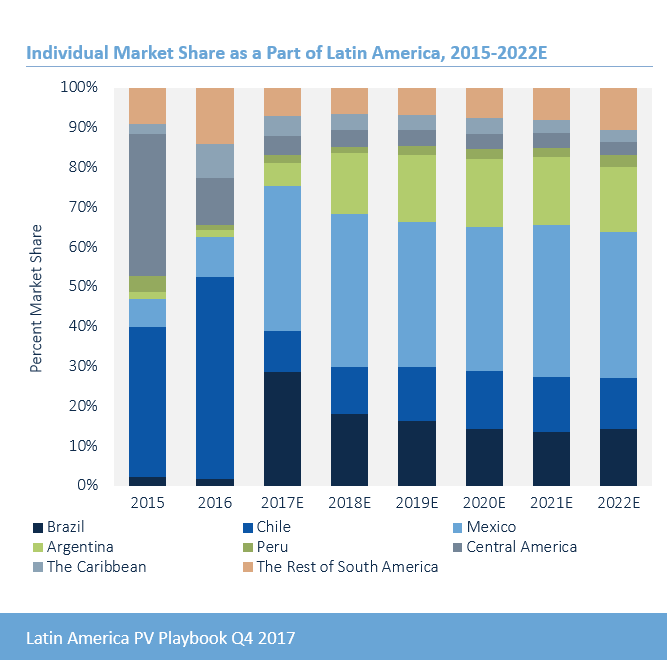
On a recent chart from Greentech Media Latin America PV Playbook, Mexico takes close to 40% share of LatAm PV demand in 2017 on the heels of utility + DG solar installations to close out the year.  Mexico has over 6 GW of PV in the pipeline to take a dominant share of LatAm PV over the next 5 years.

Are you ready for the Latin America solar revolution? Start a career with SEI in 2018, our Solar Professional Certificate Program in Spanish is the most complete technical training in the entire LatAm solar industry. Classes start on February, 26, save your spot!

If you are attending the summit, we will be happy to meet you. Get in touch with our Marketing and Communication Manager LatAm, María Pía Day to set a meeting : pia@solarenergy.org / +1 970 527 5042 ext 201.


The post Solar Energy International (SEI) will be attending Greentech Media Mexico Summit 2018 appeared first on Solar Training - Solar Installer Training - Solar PV Installation Training - Solar Energy Courses - Renewable Energy Education - NABCEP - Solar Energy International (SEI).

Solar, in spite of the tariff, will continue to thrive and disrupt

A message from Kathy Swartz, Solar Energy International Executive Director

Dear Friends and Alumni of SEI,

On Monday, January 22, the Trump Administration made a deciding call on the anticipated solar trade case, announcing a 30 percent tariff on imported solar cells and modules, to taper off by five percent over four years. While we are disappointed in this decision, this is not doom and gloom. Solar Energy will continue to thrive because of public support, the relatively small increase that this tariff will actually cost,  the resilience of solar companies who have succeeded in spite of policy, and a rapidly growing international market. The disruptive “solar cat” is out of the bag and at this point, there’s no putting it back in!

Solar has tremendous public support. Public support of solar is at at an all-time high. According to the Pew Research Center, in 2016, “just 4% of Americans report having home solar panels but many more − 37% − say they are giving it serious thought” and 89% of Americans favor solar farms.  

Consumers are motivated more than ever, whether it be because of the strong economic benefit of installing PV, or the new technology that is  changing the market, or the desire to be energy independent especially due to natural disasters, such as hurricanes and wildfires, that can wipe out the grid for many months, as we’ve seen in Puerto Rico. Tariff or not, public support for solar will only continue to increase. As a consumer, if you don’t like this tariff, then send a clear message by contacting your local solar installer and go solar.

The tariff only applies to a small percentage of the total system cost. The cost to install solar has dropped over 70% since 2010!  The tariff only applies to modules (and only certain modules at that) and not the entire cost of the PV system. Essentially the tariff increases the cost of modules to where it was about two years ago, which were exceptional years in terms of amount of solar installed. Though the profit margins will be a little less for developers and installation companies, there are margins nonetheless.

According to the Office of Energy Efficiency and Renewable Energy, “the soft costs of solar account for as much as 64% of the total cost of a new solar system. These barriers are often the result of a lack of information needed to do a job or make a decision.” What does this mean? Training is more important than ever because it creates employees who have the skills and knowledge to do the job right, which reduces soft costs and more than compensates for the price increase due to the tariff on modules .

US solar companies are resilient. With over 60,000 alumni, we know so many solar companies, and these companies, many of them small to mid-sized, have figured out ways to thrive in spite of a changing energy landscape. This includes the roller coaster of incentives including last year’s uncertainty about the Investment Tax Credit, utilities trying to change policies, two previous trade cases, and increased competition. And in spite of all of this, the solar market continues to grow.

There’s a rapidly growing international market. The tariff may glut the international market with modules, which in turn will lower the already historic low price of modules, and will drive more development. For example, one of our international partners was just notified by their Chinese supplier that the price of modules will reduce by 10% as a result of the tariff. This creates even more opportunities for electrifying rural communities, stabilizing grids, and powering homes, bringing us one step closer to a world powered by renewable energy.

As an industry-leading, educational non-profit, Solar Energy International supports solar jobs through industry recognized technical training to build a thriving solar industry to achieve our organizational vision of a world powered by renewable energy. As Tesla’s Elon Musk said, “I could either watch it happen or be part of it.” You, our friends and alumni, have chosen to be part of this,  and regardless of the tariff, our industry will continue to disrupt how we get our energy by producing reliable, cost-effective, clean electricity. And there’s no stopping us now!

Onward, upward,

Kathryn Swartz, Executive Director


PS: If I may, I’d like to get personal for a moment. I grew up in a small town in Northwest Ohio. It was home of many factories, including American Standard. My dad worked there and we had a good middle-class life. My siblings and I put ourselves through college by working there in the summer, inspecting toilet tanks. The factory was relocated as a result of trade agreements, and with it went good-paying jobs, because of the promise of more profit for shareholders. I understand the desire to bring back American manufacturing jobs, however, there were so many other ways to encourage all manufacturing in the United States other than creating obstacles for industries that are providing good jobs that can’t be outsourced. As a country, we can do better.

The post Solar, in spite of the tariff, will continue to thrive and disrupt appeared first on Solar Training - Solar Installer Training - Solar PV Installation Training - Solar Energy Courses - Renewable Energy Education - NABCEP - Solar Energy International (SEI).

Wednesday, January 24, 2018

Thoughts on the Solar Tariffs

The Trump Administration has enacted tariffs on imported solar cells and larger modules (as well as on washing machines). In general, tariffs are counterproductive, because they only help some producers at the expense of others, and they unambiguously raise prices for consumers. That logic applies to this case as well. However, insofar as the American solar companies that import cells and modules are some of the biggest losers in this deal, they have little grounds for complaint, as they are already receiving lavish benefits from provisions in the tax code. Two wrongs don’t make a right, to be sure, but employment in the renewables sector is arguably closer to the “natural” level after this latest move by the federal government.

The Context for the Announcement

The tariffs on solar cells and modules start at 30 percent in the first year, and then fall by 5 percentage points until reaching 15 percent. According to the Administration, the purpose of the tariffs is to correct for the distortion in trade caused by the Chinese government’s use of “state incentives, subsidies, and tariffs to dominate the global supply chain” in this arena.

Back in the fall, the U.S. International Trade Commission recommended that the federal government enact tariffs in response to China’s allegedly unfair practices. Indeed, the Obama Administration had reached a similar conclusion, as CNBC explains:

The Obama administration twice placed tariffs on solar imports from China, but Chinese companies skirted the penalties by moving production to neighboring countries. The Trump administration’s tariffs close that loophole by applying tariffs to all solar cell and module imports.

I personally don’t recall as much outrage over the Obama Administration’s moves when they occurred.

Tariffs, a Blunt and Inefficient Instrument

In general, economists from across the political spectrum agree that tariffs are a very blunt instrument, and reduce economic efficiency. They, of course, have the ability to help certain producers—that’s why tariffs exist—but in general, the gains to the winners are smaller than the losses to the losers. As such, when the U.S. government imposes a new tariff, it makes Americans per capita poorer than they otherwise would be.

The pithiest case against tariffs was penned by Henry George, who observed: “What protection teaches us, is to do to ourselves in time of peace what enemies seek to do to us in time of war.” (Quote from page 47 here.) For an introduction to the economic case for free trade in modern, plain language, see the chapter in my textbook. For a classic critique of “protectionism,” read the famous satire by the masterful Bastiat.

When it comes to our current situation, the new tariffs will help U.S. manufacturers of solar equipment. Indeed, it was two U.S.-based companies—Suniva and SolarWorld—that brought the case to the government’s attention. By artificially raising the price of imports, the tariffs make it easier for U.S. manufacturers to compete, and thus the move arguably “creates jobs” for such companies. However, these potential job gains are offset by the loss of jobs of U.S. companies that use solar cells and modules, because the higher prices will ultimately mean fewer sales in renewables at the consumer level. These analyses are always guesswork, but according to one estimate quoted by CNBC:

Imposing tariffs could create as many as 6,400 solar manufacturing positions, but job losses in other parts of the industry would almost certainly exceed those gains, an independent analysis by Bloomberg New Energy Finance performed for Utility Dive found.

So to summarize, compared to the situation a month ago, the new tariff on solar cells and modules makes Americans poorer on net. It doesn’t create jobs per se, it just shuffles them around. And by artificially making imports more expensive, it merely reduces options for U.S. consumers.

Remember that a tariff is a tax on potential purchases that Americans want to make. Fans of the free market should not be surprised to learn that the textbook analysis says a tariff (generally speaking) makes Americans poorer, on average, because its artificial incentives make production less efficient. That’s what taxes do.

It’s true that we don’t have a free market in global trade. However, if the Chinese government wants to subsidize its exports of solar products, then that makes the Chinese people poorer. In the limit, if the Chinese government bought up products and then sent them as gifts to Americans, that would be a pure transfer of wealth from China to the United States. Getting gifts from foreigners doesn’t make us poorer, on net, even though the particular type of gift could hurt particular U.S. firms and their workers.

U.S. Renewables Sector Has Little Grounds for Complaint

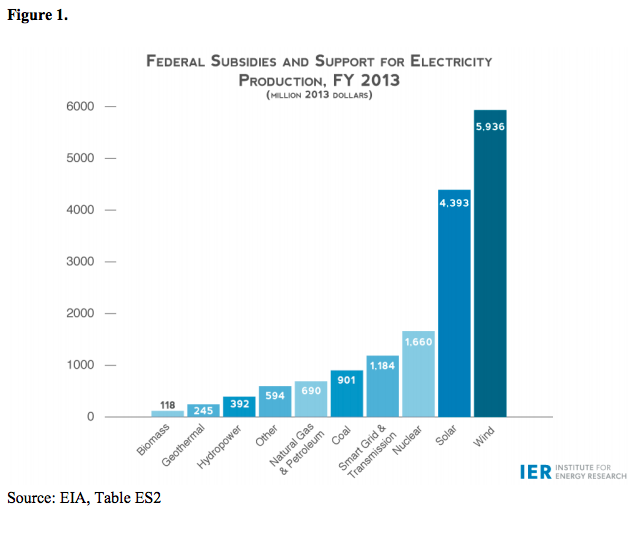
Having said all of the above, the one group who can’t complain about the impact of the new tariffs is the U.S. renewables sector. These firms are already benefiting from artificial tax code support, in the form of the Production Tax Credit (PTC) and Investment Tax Credit (ITC). (Note that the eligibility has changed over the years, but solar operations from the past and not claiming the ITC can still claim the PTC.) Consider Figure 1 below, taken from my March 2017 Congressional testimony on energy subsidies in the tax code:

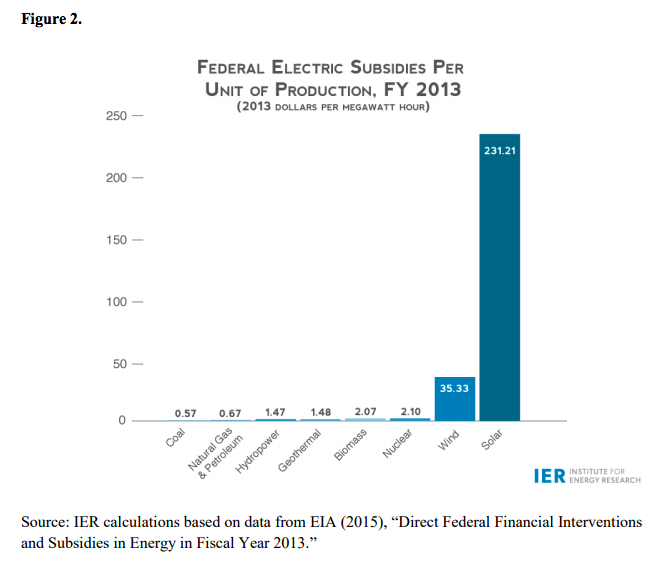
The above chart shows the total dollar amounts (based on government statistics). Things are even more lopsided when we account for the amount of electricity actually produced by the various sources:

As these figures make perfectly clear, U.S. solar producers are the last group in the world who can complain about unfair tax treatment leading to distortions.

Conclusion

As I explained in my testimony last year, the federal tax code artificially boosts the market share of wind and solar power in the United States. Now, the new tariffs enacted by the Trump Administration will reshuffle that artificially high amount, reducing the number of workers in solar installation (for example) while boosting the number of workers in solar manufacturing. Even so, the total number of U.S. workers in “solar” is still artificially high, compared to a situation where the U.S. tax code just applied the same rate to all firms, and didn’t have special credits for some domestic firms, or penalties on foreign imports.

In general, tariffs are a very blunt instrument and a poor device for making Americans more prosperous. However, the U.S. firms who are the direct “losers” of the new solar tariffs have little grounds for complaint, since they’ve been benefiting for years from favorable tax treatment.

The post Thoughts on the Solar Tariffs appeared first on IER.

Preparing for NABCEP’s three new specialty certification exams with SEI’s solar installer training courses

This month, The North American Board of Certified Energy Practitioners (NABCEP) officially announced three new specialty certifications. According to the NABCEP website, the certifications were developed in partnership with the U.S. Department of Energy (DOE)’s Sunshot Initiative, in an effort to reflect the demands of the solar industry. So how does Solar Energy International (SEI)’s solar installer training prepare students for these new certifications?

The three new certifications are: PV Design Specialist, PV Installer Specialist, and PV Commissioning & Maintenance Specialist. According to Breccia Cressman, SEI’s Director of Student Services,  “Many SEI students that have decided to pursue one of the three specialty certifications are asking what training path is recommended as they work towards taking these new NABCEP exams.”  

SEI Director of Curriculum & Instruction Sarah Wilder compiled recommended SEI coursework specifically for each NABCEP certification exams:

PV Design Specialist:

PV Installer Specialist:

PV Commission & Maintenance Specialist:

Sarah added, “solar professionals already working in the industry who focus on one of these specialty areas may be able to test out of the fundamentals courses (PV101 and PV203) and sign up for advanced-level courses (PV202 and PV350/351L) to satisfy the educational requirements of the new exams.”

For students seeking SEI comprehensive training, Breccia noted, “As you can see, SEI’s Solar Professionals Certificate Training paths will cover the majority of the topics being tested upon in these specialty certification exams.” The Solar Professional Certificate Training Program, offered by SEI, is the industry’s most rigorous training program to prepare professionals for the highly technical clean energy workforce. Students can apply for enrollment in the program, and upon acceptance, can receive a certificate after completing a specific track of classes. The Solar Professional Certificate Program has available tracks in Residential and Commercial Photovoltaic Systems Certificate, Battery-Based PV, Solar Business and Technical Sales, and more.

Sign up for SEI solar installer training today and kickstart your career in the solar industry.

The post Preparing for NABCEP’s three new specialty certification exams with SEI’s solar installer training courses appeared first on Solar Training - Solar Installer Training - Solar PV Installation Training - Solar Energy Courses - Renewable Energy Education - NABCEP - Solar Energy International (SEI).

Tuesday, January 23, 2018

An Entirely Predictable Bankruptcy

On Monday, Philadelphia Energy Solutions (PES) announced it is filing for bankruptcy. PES operates the largest oil-refining complex on the east coast, with its two refineries capable of processing 335,000 barrels of oil per day. In filing for bankruptcy, PES citied its inability to pay for the 2018 cost of complying with the Renewable Fuel Standard (RFS), which mandates ever increasing levels of biofuel be mixed into the nation’s fuel supply regardless of demand or even whether the biofuels actually exist.

The specific cost that pushed PES over the cliff is the purchasing of RINs (short for Renewable Identification Numbers). The RFS requires that a company purchase RINs to cover any biofuel volumes below the federally mandated levels. In the case of PES, a merchant refiner that only processes oil, not biofuels, this means purchasing RINs to cover their entire mandated amount. The opaqueness and volatility of the market for RINs means that this cost is highly variable and so prone to abuse that even the beneficiaries of the subsidy recognize the problem. RIN costs have soared in recent years, with PES forced to put up $217 million to purchase compliance with the RFS just in 2017—more than the company spent on all salaries and benefits for its employees.

In response to PES’s bankruptcy filing, the biofuel industry has taken the “let them eat cake” approach, accusing PES of not spending its scarce resources to modify their refineries to blend biofuels. Needless to say, the United Steelworkers disagree and have sided with PES on the need to act immediately to change the biofuels obligation.

PES is asking the bankruptcy court to free it from its RIN obligations. That may work as a short-term rescue for PES, but it does not address the long-term impact of the RFS on other refiners and the economy as a whole. To be sure, there are market conditions like new pipelines and the relative prices of different grades of oil, as well as antiquated regulations like the Jones Act, that that have also hurt PES’s bottom line. But the RFS is not a market condition, it is government theft, and that is why merely shielding PES from its current RIN liabilities is not sufficient. The RFS itself needs to be sunsetted.

Put simply, the RFS is nonsensically economically destructive. Like any government intervention, it comes at a cost. While it may prop up some biofuel producers in Iowa, it destroys jobs at refineries in places like Philadelphia and its imposed costs ripple throughout the economy.

Why must the whole of the American people be subject to higher costs just to line the pockets of a few biofuel companies? Why are jobs in Iowa more important than jobs in Pennsylvania, Texas, and elsewhere? The PES bankruptcy should serve as a wakeup call to Congress to own up to their mistake and sunset this program. While it may have benefitted a few special interests in the biofuels industry, for the American people, the RFS is all cost and no benefit. It was misguided in its creation and design, and its manifest failings have become clear in the decade plus of its operation. Whatever its lobbying power, the biofuel industry cannot be allowed to continue to handcuff the country to this foolish and destructive mandate.

The post An Entirely Predictable Bankruptcy appeared first on IER.

Why Search Agencies Should Embrace the Adjacency of Email Marketing

Posted by davidmihm

As someone who’s spent virtually his entire career in local search, I’m by no means an early proponent of email. But in my interactions at marketing conferences, studies of industry research, and social media conversations, I get the feeling that many of my peers are even further down the adoption curve than I’ve been.

With this post, I encourage you to take a hard look at email marketing for yourselves, or an even harder look if you’ve already done so. If you’ve focused exclusively on offering SEO and SEM services to clients in the past, I hope I’ll convince you that email should be a natural and profitable complement to those offerings.

And if you’re a local business reading this post, I hope many of these points convince you to take a look at email marketing yourselves!

Making the case for email

High ROI

With a return on investment (ROI) of 44:1, marketers consistently rate email as the top-performing channel. According to Campaign Monitor, that ROI has actually increased since 2015, and it’s particularly true for B2B companies. Despite the supposed unpopularity of email among millennials, it remains far and away the most-preferred channel by which to receive communication from a business.

Just plain cheap

The fact that email’s so cheap helps the denominator of that 44:1 stat a bunch. Mailchimp is free up to 2,000 subscribers, as are MailerLite and SendinBlue, and many other providers offer plans under $10/month depending on your number of subscribers.

It’s also cheap in terms of time cost. Unlike social media where daily or even hourly presence performs best, email allows you to duck in and duck out as you have time.

As far as the numerator, average open rates far exceed social media reach on most platforms. And even if they don’t open, ⅓ of people report purchasing based on an email they received from a brand (!). Search provides better purchase intent, but the top-of-mind awareness and referral potential from email is unmatched.

Makes other channels more effective

Gathering customer email addresses is essential for other critical forms of local business marketing already — you need an email address to ask for a review, build lookalike audiences, and make customer intelligence solutions like FullContact most effective.

Actually offering something of value, whether that’s a discount code, loyalty program, whitepaper, or newsletter subscription, increases the odds of earning that email address for all of those purposes.

Last best option?

Frankly, the number of organic digital channels available to small businesses is shrinking. Facebook’s latest announcement signals a tough road ahead there for businesses without the budget to Boost posts, and Google’s expansion of its Local Service Ad program to verticals and locales across the United States in the next couple of years seems inevitable to me. Now is the time to start building an email program as these monetization pressures intensify.

Why agencies should offer email

Your customers know it works.

Local businesses might be more aware of email’s potency than some of the agencies that are serving them. Email consistently rates among the top three marketing channels in industry surveys by the Local Search Association, StreetFight, Clutch, and more.

At the very least, email requires barely any client education. Unlike the black box of SEO or the complexity of PPC, by and large, small businesses inherently understand email marketing. They know they should be sending emails to their customers, but many of them just aren’t yet doing it, or are doing it poorly.

It’s a concrete deliverable.

Unlike so much of the behind-the-scenes work that leads to success in SEO, clients can actually see an email campaign delivered to their inbox, as well as the results of that campaign: every major Email Service Provider tracks opens and clicks by default.

It leverages existing offerings.

I already mentioned some of the ways that email marketing complements other channels above. But it can tie in even more closely to an agency’s existing content offering: many of you are already developing full content calendars, or at the very least social content.

<pitch>(For those clients whom you’re helping with social media, their newsletter can be built using Tidings with no additional effort on your part.)</pitch>

Building email into your client content strategy can help their content reach a deeper audience, and possibly even a different audience.

It’s predictable.

Though you could argue that the Gmail and Apple Mail interface configurations are algorithms of a kind, generally speaking, email marketing is not subject to wild algorithmic changes or inexplicable ranking fluctuations.

And unlike Google’s unrealistic link building axiom that great content will naturally attract inbound links, great content actually does naturally attract more subscribers and more customers as they receive forwarded emails.

You can expand it over time.

Unlike SEO for local businesses, which generally includes relatively easy wins up front and gets progressively harder to deliver the same value over time, email marketing offers numerous opportunities to expand the scope of your engagement with a client.

Beyond fulfilling the emails themselves, there are plenty of other email-related services to offer, including managing and optimizing list sign-up, welcome emails and drip campaigns, A/B testing subject lines and content, and ongoing customer intelligence.

Tactical ingredients for success with email

Use a reputable Email Service Provider.

Running an email marketing program through Gmail or Outlook is an easy way to get your primary address blacklisted. You also won’t have access to open rate or click rate, nor an easy way to automate signups onto specific lists or segments.

Be consistent.

Setting expectations for your subscribers and then following through on those expectations is a particularly important practice for email newsletters, but also holds true for explicitly commercial emails and automated emails.

You should be generally consistent with the day on which you send weekly specials, appointment reminders, or service follow-ups. Consistency helps form a habit among your subscribers.

Consistency also applies to branding. It’s fine to A/B test subject lines and content types over time, but don’t shoot yourself in the foot from a brand perspective by designing every email you send from scratch. Leave that kind of advanced development to big brands with full in-house email teams.

The other reason to be consistent is that designing for email is really, really difficult — a lesson I learned the hard way last year prior to launching Tidings. Complex email clients like Microsoft Outlook use their own markup languages to render emails, and older email clients can’t interpret a lot of modern HTML or CSS declarations.

Choose a mobile-first template.

Make sure your layout renders well on phones, since that’s where more than 2/3 of email gets opened. Two- or three-column layouts that force pinching and zooming on mobile devices are a no-no, and at this point, most subscribers are used to scrolling a bit to see content.

As long as your template reflects your brand accurately, the content of that layout is far more important than its design. Look no further than the simple email layouts chosen by some of the most successful companies in their respective industries, including Amazon, Kayak, and Fast Company.

Pick a layout that’s proven to work on phones and stick with it.

Include an email signup button or form prominently on your website.

It’s become a best practice to include social icons in the header and/or footer of your website. But there’s an obvious icon missing from so many sites!

An email icon should be the first one in the lineup, since it’s the channel where your audience is most likely to see your content.

Also consider using Privy or Mailmunch to embed a signup banner or popover on your website with minimal code.

The specific place of newsletters

Plenty of people way smarter than me are on the newsletter bandwagon (and joined it much earlier than I did). Moz has been sending a popular “Top 10” newsletter for years, Kick Point sends an excellent weekly synopsis, and StreetFight puts out a great daily roundup, just to name a few. As a subscriber, those companies are always top-of-mind for me as thought leaders with their fingers on the pulse of digital marketing.

But newsletters work far beyond the digital marketing industry, too.

Sam Dolnick, the man in charge of the New York Times’ digital initiatives, puts a lot of stock in newsletters as a cornerstone channel, calling them “a lo-fi way to form a deep relationship with readers.”

I love that description. I think of a newsletter as a more personalized social channel. In the ideal world it’s halfway between a 1:1 email and a broadcast on Facebook or Twitter.

Granted, a newsletter may not be right for every local business, and it’s far from the only kind of email marketing you should be doing. But it’s also one of the easiest ways to get started with email marketing, and as Sam Dolnick said, an easy-to-understand way to start building relationships with customers.

For more newsletter best practices, this ancient (1992!) article actually covers print newsletters but almost all of its advice applies equally well to digital versions!

A great option or a strategic imperative?

Facebook’s ongoing reduction in organic visibility, Google’s ongoing evolution of the local SERP, and the shift to voice search will combine to create an existential threat to agencies that serve smaller-budget local businesses over the next 2–3 years.

Agencies simply can’t charge the margin to place paid ads that they can charge for organic work, particularly as Google and Facebook do a better and better job of optimizing low-budget campaigns. More ads, more Knowledge Panels, and more voice searches mean fewer organic winners at Google than ever before (though because overall search volume won’t decline, the winners will win bigger than ever).

Basic SEO blocking-and-tackling such as site architecture, title tags, and citation building will always be important services, but their impact for local businesses has declined over the past decade, due to algorithmic sophistication, increased competition, and decreased organic real estate.

To grow or even maintain your client base, it’ll be critical for you as an agency to offer additional services that are just as effective and scalable as these techniques were a decade ago.

As a concrete, high-margin, high-ROI deliverable, email should be a centerpiece of those additional services. And if it just doesn’t feel like something you’re ready to take on right now, Tidings is happy to handle your referrals :D!


Sign up for The Moz Top 10, a semimonthly mailer updating you on the top ten hottest pieces of SEO news, tips, and rad links uncovered by the Moz team. Think of it as your exclusive digest of stuff you don't have time to hunt down but want to read!

Monday, January 22, 2018

An Investigation Into Google’s Maccabees Update

Posted by Dom-Woodman

December brought us the latest piece of algorithm update fun. Google rolled out an update which was quickly named the Maccabees update and the articles began rolling in (SEJ , SER).

The webmaster complaints began to come in thick and fast, and I began my normal plan of action: to sit back, relax, and laugh at all the people who have built bad links, spun out low-quality content, or picked a business model that Google has a grudge against (hello, affiliates).

Then I checked one of my sites and saw I’d been hit by it.

Hmm.

Time to check the obvious

I didn’t have access to a lot of sites that were hit by the Maccabees update, but I do have access to a relatively large number of sites, allowing me to try to identify some patterns and work out what was going on. Full disclaimer: This is a relatively large investigation of a single site; it might not generalize out to your own site.

My first point of call was to verify that there weren’t any really obvious issues, the kind which Google hasn’t looked kindly on in the past. This isn’t any sort of official list; it's more of an internal set of things that I go and check when things go wrong, and badly.

Dodgy links & thin content

I know the site well, so I could rule out dodgy links and serious thin content problems pretty quickly.

(For those of you who'd like some pointers on the kinds of things to check for, follow this link down to the appendix! There'll be one for each section.)

Index bloat

Index bloat is where a website has managed to accidentally get a large number of non-valuable pages into Google. It can be sign of crawling issues, cannabalization issues, or thin content problems.

Did I call the thin content problem too soon? I did actually have some pretty severe index bloat. The site which had been hit worst by this had the following indexed URLs graph:

However, I’d actually seen that step function-esque index bloat on a couple other client sites, who hadn’t been hit by this update.

In both cases, we’d spent a reasonable amount of time trying to work out why this had happened and where it was happening, but after a lot of log file analysis and Google site: searches, nothing insightful came out of it.

The best guess we ended up with was that Google had changed how they measured indexed URLs. Perhaps it now includes URLs with a non-200 status until they stop checking them? Perhaps it now includes images and other static files, and wasn’t counting them previously?

I haven’t seen any evidence that it’s related to m. URLs or actual index bloat — I'm interested to hear people’s experiences, but in this case I chalked it up as not relevant.

Appendix help link

Poor user experience/slow site

Nope, not the case either. Could it be faster or more user-friendly? Absolutely. Most sites can, but I’d still rate the site as good.

Appendix help link

Overbearing ads or monetization?

Nope, no ads at all.

Appendix help link

The immediate sanity checklist turned up nothing useful, so where to turn next for clues?

Internet theories

Time to plow through various theories on the Internet:

  1. The Maccabees update is mobile-first related
    • Nope, nothing here; it’s a mobile-friendly responsive site. (Both of these first points are summarized here.)
  2. E-commerce/affiliate related
    • I’ve seen this one batted around as well, but neither applied in this case, as the site was neither.
  3. Sites targeting keyword permutations
    • I saw this one from Barry Schwartz; this is the one which comes closest to applying. The site didn’t have a vast number of combination landing pages (for example, one for every single combination of dress size and color), but it does have a lot of user-generated content.

Nothing conclusive here either; time to look at some more data.

Working through Search Console data

We’ve been storing all our search console data in Google’s cloud-based data analytics tool BigQuery for some time, which gives me the luxury of immediately being able to pull out a table and see all the keywords which have dropped.

There were a couple keyword permutations/themes which were particularly badly hit, and I started digging into them. One of the joys of having all the data in a table is that you can do things like plot the rank of each page that ranks for a single keyword over time.

And this finally got me something useful.

The yellow line is the page I want to rank and the page which I’ve seen the best user results from (i.e. lower bounce rates, more pages per session, etc.):

Another example: again, the yellow line represents the page that should be ranking correctly.

In all the cases I found, my primary landing page — which had previously ranked consistently — was now being cannabalized by articles I’d written on the same topic or by user-generated content.

Are you sure it’s a Google update?

You can never be 100% sure, but I haven’t made any changes to this area for several months, so I wouldn’t expect it to be due to recent changes, or delayed changes coming through. The site had recently migrated to HTTPS, but saw no traffic fluctuations around that time.

Currently, I don’t have anything else to attribute this to but the update.

How am I trying to fix this?

The ideal fix would be the one that gets me all my traffic back. But that’s a little more subjective than “I want the correct page to rank for the correct keyword,” so instead that’s what I’m aiming for here.

And of course the crucial word in all this is “trying”; I’ve only started making these changes recently, and the jury is still out on if any of it will work.

No-indexing the user generated content

This one seems like a bit of no-brainer. They bring an incredibly small percentage of traffic anyway, which then performs worse than if users land on a proper landing page.

I liked having them indexed because they would occasionally start ranking for some keyword ideas I’d never have tried by myself, which I could then migrate to the landing pages. But this was a relatively low occurrence and on-balance perhaps not worth doing any more, if I’m going to suffer cannabalization on my main pages.

Making better use of the Schema.org "About" property

I’ve been waiting a while for a compelling place to give this idea a shot.

Broadly, you can sum it up as using the About property pointing back to multiple authoritative sources (like Wikidata, Wikipedia, Dbpedia, etc.) in order to help Google better understand your content.

For example, you might add the following JSON to an article an about Donald Trump’s inauguration.

[
          {
            "@type": "Person",
            "name": "President-elect Donald Trump",
            "sameAs": [
              "https://en.wikipedia.org/wiki\Donald_Trump",
              "http://dbpedia.org/page/Donald_Trump",
              "https://www.wikidata.org/wiki/Q22686"
            ]
          },
          {
            "@type": "Thing",
            "name": "US",
            "sameAs": [
              "https://en.wikipedia.org/wiki/United_States",
              "http://dbpedia.org/page/United_States",
              "https://www.wikidata.org/wiki/Q30"
            ]
          },
          {
            "@type": "Thing",
            "name": "Inauguration Day",
            "sameAs": [
              "https://en.wikipedia.org/wiki/United_States_presidential_inauguration",
              "http://dbpedia.org/page/United_States_presidential_inauguration",
              "https://www.wikidata.org/wiki/Q263233"
            ]
          }
        ]

The articles I’ve been having rank are often specific sub-articles about the larger topic, perhaps explicitly explaining them, which might help Google find better places to use them.

You should absolutely go and read this article/presentation by Jarno Van Driel, which is where I took this idea from.

Combining informational and transactional intents

Not quite sure how I feel about this one. I’ve seen a lot of it, usually where there exist two terms, one more transactional and one more informational. A site will put a large guide on the transactional page (often a category page) and then attempt to grab both at once.

This is where the lines started to blur. I had previously been on the side of having two pages, one to target the transactional and another to target the informational.

Currently beginning to consider whether or not this is the correct way to do it. I’ll probably try this again in a couple places and see how it plays out.

Final thoughts

I only got any insight into this problem because of storing Search Console data. I would absolutely recommend storing your Search Console data, so you can do this kind of investigation in the future. Currently I’d recommend paginating the API to get this data; it’s not perfect, but avoids many other difficulties. You can find a script to do that here (a fork of the previous Search Console script I’ve talked about) which I then use to dump into BigQuery. You should also check out Paul Shapiro and JR Oakes, who have both provided solutions that go a step further and also do the database saving.

My best guess at the moment for the Maccabees update is there has been some sort of weighting change which now values relevancy more highly and tests more pages which are possibly topically relevant. These new tested pages were notably less strong and seemed to perform as you would expect (less well), which seems to have led to my traffic drop.

Of course, this analysis is currently based off of a single site, so that conclusion might only apply to my site or not at all if there are multiple effects happening and I’m only seeing one of them.

Has anyone seen anything similar or done any deep diving into where this has happened on their site?


Appendix

Spotting thin content & dodgy links

For those of you who are looking at new sites, there are some quick ways to dig into this.

For dodgy links:

  • Take a look at something like Searchmetrics/SEMRush and see if they’ve had any previous penguin drops.
  • Take a look into tools Majestic and Ahrefs. You can often get this free, Majestic will give you all the links for your domain for example if you verify.

For spotting thin content:

  • Run a crawl
    • Take a look at anything with a short word count; let’s arbitrarily say less than 400 words.
    • Look for heavy repetition in titles or meta descriptions.
    • Use the tree view (that you can find on Screaming Frog, for example) and drill down into where it has found everything. This will quickly let you see if there are pages where you don’t expect there to be any.
    • See if the number of URLs found is notably different to the indexed URL report.
  • Soon you will be able to take a look at Google’s new index coverage report. (AJ Kohn has a nice writeup here).
  • Browse around with an SEO chrome plugin that will show indexation. (SEO Meta in 1 Click is helpful, I wrote Traffic Light SEO for this, doesn’t really matter what you use though.)

Index bloat

The only real place to spot index bloat is the indexed URLs report in Search Console. Debugging it however is hard, I would recommend a combination of log files, “site:” searches in Google, and sitemaps when attempting to diagnose this.

If you can get them, the log files will usually be the most insightful.

Poor user experience/slow site

This is a hard one to judge. Virtually every site has things you can class as a poor user experience.

If you don’t have access to any user research on the brand, I will go off my gut combined with a quick scan to compare to some competitors. I’m not looking for a perfect experience or anywhere close, I just want to not hate trying to use the website on the main templates which are exposed to search.

For speed, I tend to use WebPageTest as a super general rule of thumb. If the site loads below 3 seconds, I’m not worried; 3–6 I’m a little bit more nervous; anything over that, I’d take as being pretty bad.

I realize that’s not the most specific section and a lot of these checks do come from experience above everything else.

Overbearing ads or monetization?

Speaking of poor user experience, the most obvious one is to switch off whatever ad-block you’re running (or if it’s built into your browser, to switch to one without that feature) and try to use the site without it. For many sites, it will be clear cut. When it’s not, I’ll go off and seek other specific examples.


Sign up for The Moz Top 10, a semimonthly mailer updating you on the top ten hottest pieces of SEO news, tips, and rad links uncovered by the Moz team. Think of it as your exclusive digest of stuff you don't have time to hunt down but want to read!