Friday, May 31, 2019

Thursday, May 30, 2019
Forget Paris: On the Second Anniversary of Trump’s Pullout
Two years ago, President Trump announced he would begin the formal process of withdrawing the United States from the Paris Climate Agreement. At the time, the media and climate alarmists went ballistic—for example, famed physicist Stephen Hawking said Trump’s action would push Earth “over the brink.” And yet, as I’ll show in this article, the Paris Agreement has always been a giant exercise in symbolism over substance; it wouldn’t come close to solving the climate “problem,” even on the terms of the alarmists. Whether one thinks climate change is a minor issue to watch, or a full-blown existential crisis, either way Trump’s action should be welcomed. By challenging the reverence for the Paris Agreement, Trump’s pullout gave permission for scientists and others to think about alternative approaches rather than globally-coordinated political control over energy and transportation.
Paris Agreement Was Going to “Fail” Even On Its Own Terms
The most important point to emphasize is that the Paris Agreement was not going to deliver humanity from the scourge of climate change, if we stipulate the alarmist rhetoric for the sake of argument. From the website ClimateActionTracker.org, here is the latest estimate of the Paris pledges and the implied level of global warming through the year 2100:
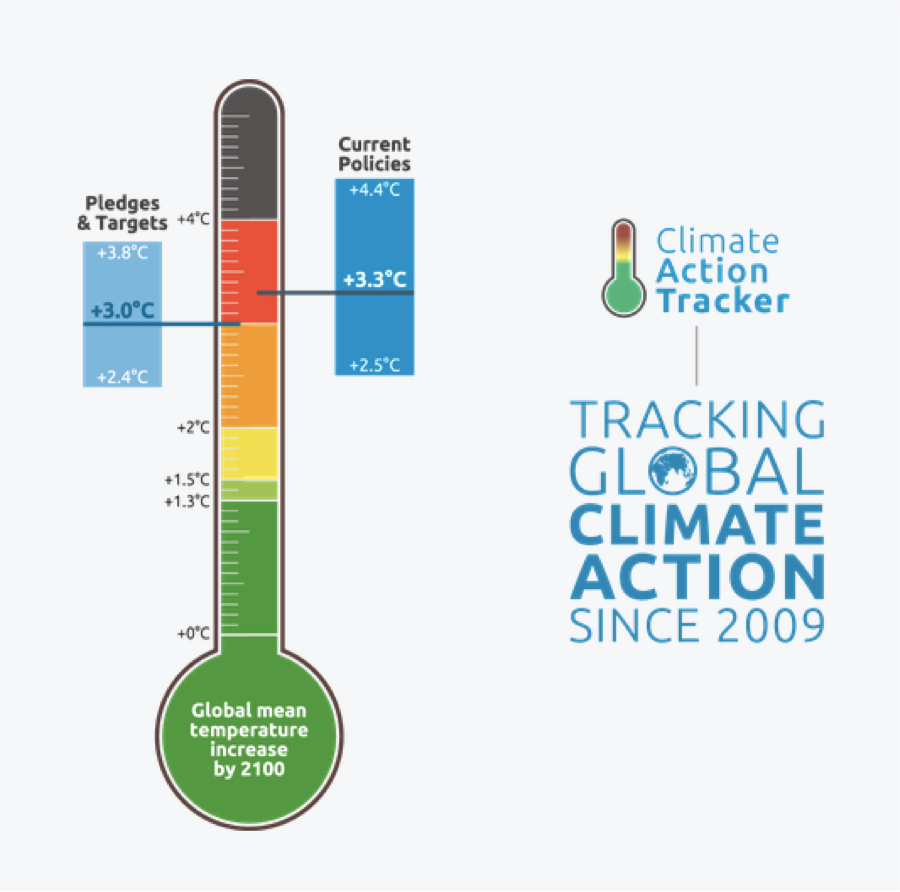
As the figure shows, even if all of the countries (including the U.S., which is still technically part of the Agreement) met their Paris pledges, warming is projected to hit 3.0 degrees Celsius—well beyond the “safe” levels of either 1.5 or at most 2.0 degrees, which are the now-fashionable targets.
What’s worse, the figure also shows that the actual policies now in place will yield projected warming of 3.3 degrees Celsius, because it’s easier to promise to do something than to actually do it.
For another piece of evidence, consider that back in April 2017, David Roberts at Vox updated his article arguing that no country on Earth was taking the then-popular 2 degrees Celsius target seriously. Note that this was before Trump made his announcement about Paris.
For these reasons, we shouldn’t take seriously the argument that Paris would’ve worked just great, thank you very much, except that Donald Trump came along and ruined it. (Rob Bradley patiently dismantles that particular claim over at MasterResource.)
Empty Pledges Are a Feature, Not a Bug
Now to be sure, the fans of the Paris Agreement would dismiss my criticism above, by arguing that once the basic framework of a global agreement is in place, then we can tighten down the screws and get some serious emission reductions.
Yet this is foolish optimism. The only reason so many countries signed up for Paris is that the pledges were non-binding, and beyond that, in many cases the pledges were virtually meaningless.
For example, Oren Cass back in 2015 explained that the “Intended National Determined Contributions” (INDC) of India and China were arguably less ambitious than what would probably happen under business-as-usual. In other words, India and China’s initial “bids” for what they could do to help in the battle against climate change, involved no actual sacrifice since it’s normal for countries to reduce their emissions-per-unit-of-GDP over time.
Even more hilarious, in a 2017 article Cass quoted from Pakistan’s pledge, which was “committed to reduce its emissions after reaching peak levels to the extent possible.” If you think about it, every country could quite confidently make such a pledge: Once emissions reach their peak, they would come down thereafter. That’s why the peak level would be a peak, after all.
To repeat, this is not a coincidence. The only way to get all of the governments of the world to sign on to Paris, was for them each to realize that they weren’t actually on the hook for anything. (Incidentally, the reason it’s the Paris Agreement and not the Paris Treaty is that the framers didn’t want the U.S. Senate during the Obama years to get a crack at rejecting it—the way they voted down the Kyoto Protocol during Bill Clinton’s Administration. This isn’t my conspiracy theory; the fans of aggressive government intervention on climate say the same thing.)
For this reason, it’s duplicitous for fans of Paris to cite it as a robust political framework with which to “get serious” about emission reductions. The near-unanimity of the deal would fall apart, once individual countries were expected to sacrifice their economic growth and take one for the team. Just look at the squabbling and chaos as more and more governments experience voter backlash against restrictions on conventional energy. Here’s how a lamenting New York Times article explained the situation back in December:
In August [2018], an effort in Australia to transition away from coal…resulted in the ouster of the prime minister. The man who succeeded him, Scott Morrison, endeared himself to the industry by bringing a lump of coal into Parliament.
In November, Brazilians elected Jair Bolsonaro, who had pledged to promote agribusiness interests in the Amazon forest…
In Poland, the host country of the latest United Nations talks, the right-wing president, Andrzej Duda, opened the negotiations by saying flatly that his country did not intend to abandon coal.
…Emissions in China have grown for the past two years, signaling the difficulties of shifting the country away from its coal-dependent industrial economy. Germany is having a hard time moving away from lignite because of political opposition in the country’s coal-rich east. The French president, Emmanuel Macron, faces unrest at home over a layer cake of taxes that working-class people say burdens them unfairly.
As the examples above indicate—and they ignore the plunging fortunes of aggressive climate action in Canada too—this is certainly not the fault of Donald Trump. Around the world, the natives are getting restless, and finally saying “enough is enough” to the technocratic “solutions” that drive up energy prices without even solving the ostensible problem of climate change.
Conclusion
President Trump has followed through on his campaign promises to roll back counterproductive regulations on energy, far more than most of us thought would be politically feasible. The Paris Agreement never had a chance of seriously denting global emissions, and all along has been a vehicle to redistribute wealth, to the tune of trillions of dollars, as I explained here at IER several years ago.
Since even the most ardent environmental activists admit that the Paris Agreement hasn’t come close to “solving” the problem of climate change, they should actually be thanking Trump for being the first to announce that it doesn’t work and ending this farce.
The post Forget Paris: On the Second Anniversary of Trump’s Pullout appeared first on IER.
#25: Bob Murphy on the economics of climate change
IER’s senior economist Bob Murphy recently visited Connecticut College to present on the economics of climate change. His lecture addresses the disconnect between “mainstream” climate models and proposals like the Green New Deal.
Links:
The post #25: Bob Murphy on the economics of climate change appeared first on IER.
What I Told College Students About the Economics of Climate Change
I recently gave a talk to a student group at Connecticut College on the economics of climate change. (The video is broken up into three parts on my YouTube channel: one, two, and three.) In this post I’ll summarize three of my main points: (1) There is a huge disconnect between what the published economics research actually says about government policies to limit global warming, and how the media is reporting it. (2) President Trump taking the U.S. out of the Paris Agreement doesn’t really affect anything on the margin, even if we stipulate the alarmist position on climate change. And (3) If I’m wrong, and human-caused climate change really does pose a dire threat to humanity in the next few decades, then scientists are currently working on several lines of research of practical ways to actually deal with the problem.
The “Consensus Research” Does Not Justify Radical Political Intervention
I first clarified to the students that throughout my talk, I wasn’t going to grab results from right-wing think tanks, or from “fringe” scientists who were considered cranks by their peers. On the contrary, I would be relaying results from sources such as the work of a Nobel laureate William Nordhaus (whose model on climate change policy had been one of three used by the Obama Administration) and from the UN’s own periodic report summarizing the latest research on climate change science and policy.
To demonstrate just how wide the chasm is between the actual economics research and the media treatment of these issues, I described to the students the spectacle I observed back in the fall of 2018, when on the same weekend news came out that William Nordhaus had won the Nobel Prize for his pioneering work on the economics of climate change and that the UN released a “Special Report” advising governments to try to limit global warming to 1.5 degrees Celsius.
The media treatment (sometimes in the same story) presented these events with no sense of conflict or irony, leading regular citizens to assume that Nordhaus’ Nobel-winning work supported the UN’s goals for policymakers.
But that is not true at all. Here’s a graph from a 2017 Nordhaus publication that I included in my presentation:
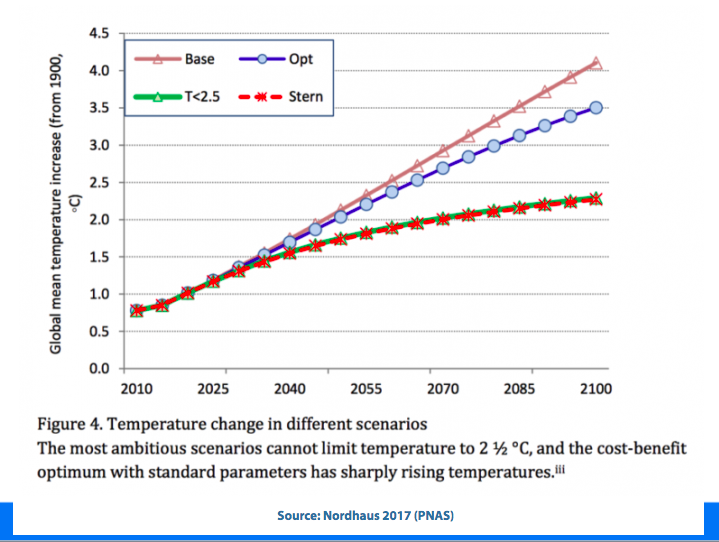
As the figure shows, Nordhaus’ model—and again, this isn’t cooked up by the Heritage Foundation, but instead was one selected by the Obama Administration’s EPA and was the reason he won the Nobel Prize—projects that if governments “did nothing,” total global warming would reach about 4.1 degrees Celsius. In contrast, if governments implemented the “optimal carbon tax,” as Nordhaus would recommend in a perfect world, then total warming would be about 3.5 degrees Celsius.
Anyone remotely familiar with the climate change policy debate knows that such an amount of warming would terrify the prominent activists and groups advocating for a political solution. They would quite confidently tell the public that warming of this amount would spell absolute catastrophe for future generations.
My point here isn’t to endorse Nordhaus’ model. My point is simply that Americans never heard anything about this when the media simultaneously covered Nordhaus’ award and the UN’s document calling for a 1.5°C limit. And yet, Nordhaus’ own work—not shown in the figure above, but I spell it out here—clearly concludes that such an aggressive target would cause far more damage to humans in the form of reduced economic output, that it would be better for governments to “do nothing” about climate change at all.
With or Without the United States, the Paris Agreement Was Going to “Fail”
To continue with the theme of how they’ve been misinformed, I reminded the students of the media’s apoplexy when Trump announced his intention to remove the United States from the Paris Climate Agreement (or treaty, in lay terms). I showed them a headline in which famed physicist Stephen Hawking said Trump was pushing the planet “over the brink.”
I then asked the students rhetorically, “You would think that the Paris Agreement was going to ‘work’ to contain the threat of climate change, except for Trump pulling out and wrecking it, right?”
And yet, the pro-intervention group ClimateActionTracker.org nicely illustrates that even if all countries met their pledges (including the U.S.), it wouldn’t come close to limiting warming to the weaker benchmark of 2°C, let alone the newer, more chic target of 1.5°C. Things were even worse if we evaluated the actual policies of governments (as opposed to what they stated they intended to do, about limiting their emissions).
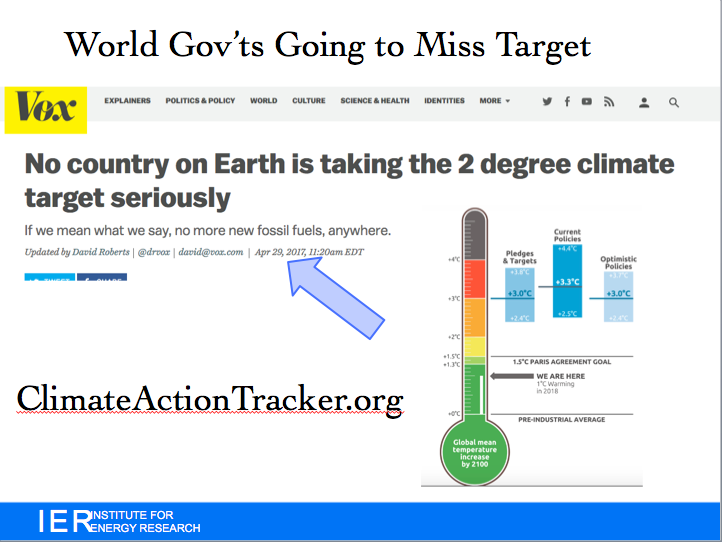
Further, I included a screenshot (in the top left of the slide) from a Vox article published before Trump’s Paris announcement, which said not a single country on Earth was taking the 2°C target seriously.
Technological Solutions
After spending so much time showing that the political “solutions” were failing even on their own terms, I summarized a few avenues of research (see this article for details) where scientists are exploring techniques to either remove carbon dioxide from the atmosphere or reflect some incoming sunlight. Although I personally do not think human-caused climate change is a crisis, and do think that adaptation coming from normal economic growth will be more than sufficient to deal with any problems along the way, nonetheless scientists do have these other techniques in their back pocket, should they become necessary to “buy humanity a few decades of breathing room” while technology advances in the transportation and energy sectors.
Conclusion
Americans, especially students, are being whipped into a panic over the allegedly existential threat of climate change. Yet the actual research, summarized in the UN’s own periodic reports and in the research of a Nobel laureate in the field, shows that at best only a modest “leaning against the wind” could be justified according to standard economic science.
By their own criteria, the alarmist activists are admitting that political measures are nowhere near achieving their goals. Their own rhetoric says that these activists are wasting everyone’s time pushing solutions that will end in catastrophe. Occasionally they slip up, as for example when Alexandria Ocasio-Cortez admits that her “we have 12 years left” was not to be taken literally.
In order to bring light to the climate change debate, at this point one just needs to actually screenshot and explain the evidence from the establishment sources. The rhetorical framing of the issue is so far removed from the underlying research that this alone is heretical.
The post What I Told College Students About the Economics of Climate Change appeared first on IER.